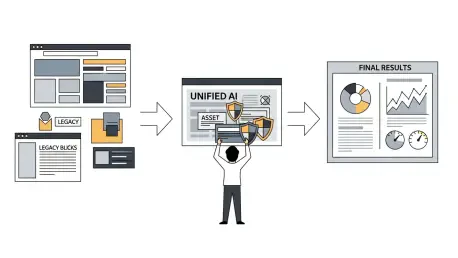

Search budgets are no longer won by the brand with the longest keyword list but by the system that predicts intent, assembles messages, and prices clicks in one motion, and Google’s AI Max for Search is the clearest signal yet that the control room of paid search has moved from manual setup to machine-led orchestration. The shift raised two questions worth testing: does consolidating targeting, creative, and bidding actually improve outcomes, and what does it cost in transparency and control?
Why AI Max Matters Now
AI Max replaced the patchwork of Dynamic Search Ads and broad-match scaffolding with a single predictive layer. Instead of starting from rules—keywords, URL targets, page feeds—it began from goals and assets, then inferred the rest. That reframing mattered because the long tail of queries had outgrown human-maintainable structures; the system promised to model intent faster than teams could codify it.
Moreover, Google positioned AI Max as default, not an experiment. Voluntary upgrades were already available, with automatic upgrades of DSA, automatically created assets, and campaign-level broad match slated to begin in September. The message was unmistakable: standard operating procedure in Search had become automation-first.
How It Works Under the Hood
At its core, AI Max fused three inputs: advertiser assets (headlines, descriptions, and approved rules), site content, and live intent signals from queries and context. The model used these streams to predict which asset mix and landing page would maximize marginal conversion value, then bid accordingly. Unlike DSA’s reliance on page text, this fusion allowed coverage of unpredictable queries that never appeared on a sitemap.
Creative assembly moved from extraction to composition. Rather than scraping a page and echoing copy, the system learned from historical performance and asset labels to build intent-aware messages on the fly. Brand rules, location parameters, and text guidelines served as guardrails, narrowing the space of valid outputs without forcing a return to micromanaged ad groups.
Features That Change Daily Work
Unified orchestration collapsed keywords, pages, and ad variants into one decision engine. That simplification shifted optimization from moving budgets between ad groups to improving inputs—assets, constraints, and conversion signals. Reporting adapted in kind: asset-level performance and search-term clusters surfaced which combinations actually created value, enabling surgical iteration instead of broad restructures.
Scale and default status were not cosmetic. Google cited an average lift of about 7% in conversions or conversion value at similar CPA or ROAS when the full feature set was enabled. Importantly, that figure indicated system headroom contingent on input quality; it did not guarantee gains if assets were thin, measurement noisy, or guardrails absent.
Migration and What Carries Over
Upgrading followed a two-step path. First came manual migration, where settings and history were ported where possible and prompts nudged users already leaning into broad match and automatically created assets. Then, beginning in September, automatic upgrades would retire DSA creation across the interface, Editor, and API, completing by month’s end.
Key controls mirrored forward—URL constraints translated to landing page preferences, while AI Max-specific features like brand rules and text policies turned on by default. The result was a simpler structure with deeper, but differently shaped, control. Teams that documented old intent rules as brand and text guidelines saw the smoothest handoffs.
Performance: Interpreting the Uplift
A 7% lift at steady CPA or ROAS sounded modest until placed in context. In mature accounts where most “obvious” queries already cleared thresholds, incremental wins typically lived in messy, low-volume clusters; humans struggled to capture them without over-segmenting. AI Max’s incremental reach into emergent and long-tail intent explained where the lift came from and why it held value at scale.
However, that average masked variance. Accounts with brittle measurement or sparse creative libraries often saw muted impact or volatility. The takeaway was disciplined: invest first in data quality—tagging, attribution, event priorities—and in diverse assets that give the model room to learn, then scale.
Differentiation: Why This and Not Competitors
Compared with Microsoft Advertising’s automation and Meta’s Advantage-style systems, AI Max’s distinction lay in how deeply it integrated search-term intent with page understanding and asset governance inside a single auction-time model. Microsoft’s stack offered similar components, but Google’s search volume and richer query context provided more training signal. Meta excelled at creative discovery within feed and video-first environments, yet lacked the explicit query layer that still defines commercial intent on the open web.
Within Google’s own portfolio, the comparison to Performance Max mattered. PMax spanned channels to maximize conversion value; AI Max constrained scope to Search while inheriting PMax’s predictive machinery and guardrails. For advertisers needing search-only control with advanced composition, AI Max became the sharper instrument.
Risks, Trade-Offs, and Mitigations
Loss of granularity remained the primary complaint. Off-brand or mismatched combinations could slip through if inputs were weak. The counter was explicit guardrails—brand rules, negative sentiment terms, and curated asset pools—to prune invalid paths without breaking automation.
Measurement drift posed a subtler threat. Aggregated optimization could hide tagging gaps or event duplication, inflating value signals that the system then chased. Routine audits, consent-aware tagging, and clear conversion hierarchies were non-negotiable. Creative debt compounded both problems: thin, repetitive assets constrained learning and forced the model to recycle middling messages.
Operational Playbook for Teams
Redefine control as input strategy. Set brand and text rules early, map landing pages to value tiers, and prioritize assets that express distinct propositions rather than micro-variations. Build a deep library that spans funnel stages and regional nuances so the system can test meaningfully.
Upgrade experimentation. Use structured tests that isolate variables—assets, guardrails, or conversion priorities—and judge outcomes on asset-level lift and query clusters, not just blended CPA. Review insights on a cadence, retire low-yield combinations, and feed high performers back into creative and landing page roadmaps.
Market Trajectory and Skill Shift
Platform-level consolidation favored predictive over reactive systems, compressing operational overhead while demanding stronger creative strategy and data governance. The center of gravity moved from hand-built account architecture to diagnosing why the model chose certain pairings and how to influence those choices without overfitting.
Expect tighter convergence with PMax and conversational creation tools. Controls and transparency were likely to expand, but the fundamental contract would hold: steer through goals and constraints, not exhaustive rules. Teams that mastered diagnostics—reading asset and query-cluster outputs—gained a durable edge.
Verdict and Next Steps
AI Max had signaled the end of the DSA era and set a new baseline for search advertising, trading mechanical setup for probabilistic orchestration and rewarding those who invested in inputs, measurement, and experimentation. The technology distinguished itself by unifying query intent, site context, and governed creative assembly at auction time, then proving consistent incremental gains where manual structures stalled. The most pragmatic path forward asked teams to lock down tagging, codify brand and text boundaries, expand asset depth, and run controlled migrations ahead of the automatic upgrades in September. Done well, AI Max turned search from a rulebook to a strategy game, and those who leaned in earliest captured both performance and the learning advantage that compounds over time.