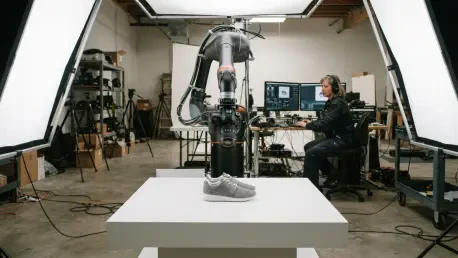

The unrelenting demand for high-fidelity digital assets has turned the traditional product photography studio into a logistical bottleneck that modern retail can no longer afford to sustain. As digital storefronts evolve into immersive environments, the gap between a physical inventory and its online representation has widened, creating a massive overhead for brands. Studio Lab, an innovative spinoff from Samsung Electronics’ C-Lab, has stepped into this vacuum by synthesizing artificial intelligence with robotic precision. This review examines how the integration of automated copywriting and intelligent hardware is not merely speeding up production but fundamentally redefining the architecture of digital commerce.
The Evolution: Commerce Content Production
Digital commerce has historically been a labor-intensive endeavor, requiring a complex choreography of photographers, editors, and copywriters. The traditional model relied on a fragmented workflow where physical products were shipped to studios, photographed manually, and then handed over to creative teams for post-production and descriptive writing. This process frequently took weeks, leading to significant delays in product launches and missed seasonal windows. The emergence of automated solutions signals a shift from this artisanal approach toward a streamlined, data-driven pipeline that treats content as a scalable resource rather than a boutique craft.
By centralizing the creative process within a single technological ecosystem, the industry is moving away from human-led friction. The transition is driven by the realization that high-volume fashion and electronics sectors require a speed that human teams cannot match without sacrificing consistency. Consequently, the role of the creative professional is shifting from manual execution to high-level curation, as automation takes over repetitive tasks like lighting, angling, and metadata generation. This evolution represents a maturation of the e-commerce infrastructure, turning content creation into a seamless extension of the supply chain.
Core Components: The Content Automation Suite
GENCY AI: Content Generation
GENCY functions as the central intelligence of this automation suite, operating as a Software as a Service platform that interprets visual data to generate marketing assets. Unlike generic large language models that often produce sterile or irrelevant copy, this system analyzes the specific physical attributes of an uploaded photo—such as fabric texture, color gradients, and structural design—to produce SEO-optimized text and persuasive narratives. This prevents the “blank page” problem for marketing teams, allowing for the creation of comprehensive detail pages in mere seconds.
The unique value of this platform lies in its ability to adhere to brand-specific tone and style constraints. By training the AI on a company’s existing aesthetic and linguistic style, the system ensures that automated outputs do not feel disconnected from the brand identity. This level of customization is crucial for mid-to-large enterprises that must maintain a cohesive voice across thousands of stock-keeping units. The platform effectively bridges the gap between raw data and consumer-facing storytelling, providing a level of scalability that was previously impossible.
GENCY PB: Robotic Photography
While software handles the digital side, GENCY PB addresses the physical limitations of product representation through a robotic arm equipped with AI vision. One of the primary criticisms of generative AI in commerce is the tendency for “hallucinations,” where software creates an idealized but inaccurate version of a product. This hardware component mitigates that risk by using real-time spatial analysis to identify the optimal camera angles and lighting setups for a physical item. The robot mimics the movements of a professional photographer but with a degree of mathematical precision that ensures every product in a line is captured with identical quality.
This robotic integration is particularly effective for items with complex geometries or varying textures that typically require hours of manual lighting adjustments. The AI vision system evaluates the shape of the object to prevent shadows or highlights that might obscure critical details. By automating the capture process, the system preserves the integrity of the product’s appearance while significantly reducing the costs associated with professional studio time. This synergy between hardware and software creates a one-stop solution that begins the moment a physical item is placed on the staging area.
Innovations: Automated Digital Marketing
The current landscape of e-commerce is characterized by a move toward hyper-personalization and platform-specific optimization. Innovations in this space are now focusing on the convergence of spatial computing and generative AI, allowing content to be tailored for different digital environments automatically. For instance, the aesthetic requirements for a luxury product on a dedicated brand site differ significantly from the visual language required for a third-party marketplace like Amazon or Shopify. Modern automation tools are beginning to offer the flexibility to adjust visual styles and copy length based on these specific destination requirements.
Furthermore, the industry is seeing a surge in experiential content automation, where robotic systems are used to create real-time memories for consumers at physical locations. This suggests that the technology is expanding beyond the warehouse and into the world of marketing events and tourism. The ability to generate professional-grade visual content instantly allows brands to engage with consumers in the physical world while maintaining a high-quality digital footprint. This blur between physical experience and digital asset generation is becoming a standard feature of the most advanced commerce solutions.
Real-World Applications: Industry Use Cases
The fashion industry has been the primary beneficiary of these advancements, with brands like Kodak Apparel and Malbon Golf leveraging automation to handle massive seasonal rotations. These companies often deal with thousands of individual pieces that must be digitized quickly to meet consumer demand. By using automated detail page creation, these brands have significantly reduced their time to market. The technology has also found a home in the electronics sector, where technical specifications must be translated into digestible, marketing-friendly content without losing accuracy.
Beyond traditional retail, the versatility of robotic vision systems has been demonstrated in unique experiential settings. Global brands such as BMW and Intel have utilized robotic photography for pop-up marketing events, providing visitors with high-end digital keepsakes that were generated autonomously. Similarly, at landmarks like the Lotte World Tower, the technology provides automated tourism photography, proving that the precision of AI-driven robotics can be applied to human subjects and scenic backgrounds. This diversification highlights that the core technology—accurate, automated visual capture—is a horizontal solution applicable to many fields.
Implementation Challenges: Market Obstacles
Despite the clear efficiency gains, the adoption of robotic content automation is not without its hurdles. The initial capital expenditure for high-end robotic hardware like GENCY PB can be a significant barrier for smaller enterprises that are used to a low-cost, albeit slower, manual workflow. While the long-term return on investment is often clear, the upfront cost remains a friction point in the market. Furthermore, the AI must undergo extensive localized training to understand the distinct design languages and aesthetic preferences of different global regions, as what works in South Korea may not resonate with a European audience.
Technical challenges also persist in the handling of highly reflective or transparent materials. Items made of glass, polished metal, or complex plastics often create optical interference for AI vision systems, leading to errors in lighting or depth perception. Developers are currently focused on improving the material intelligence of these systems to handle these edge cases without human intervention. Additionally, as the market moves toward 3D modeling and video content, the computational requirements for real-time processing are increasing, demanding more robust hardware and cloud infrastructure.
Future Outlook: Global Trajectory
The trajectory of content automation suggests a unified future where spatial computing and 3D modeling become the standard for digital retail. As e-commerce platforms move closer to virtual and augmented reality experiences, the need for automated digital twins of physical products will become paramount. Strategic expansions into international markets, particularly Japan, indicate that these automation standards are becoming a global benchmark. The focus is shifting from simple 2D images to full-motion video and interactive 3D assets that can be generated with the same ease as a static photo.
We are entering a period where the barrier to professional-grade creative work is being lowered for all market participants. Future breakthroughs are expected to involve real-time 3D reconstruction, where a robotic arm can scan an object and instantly create a high-fidelity model ready for use in a metaverse or a high-end web interface. This democratization of high-quality content will likely lead to a more competitive landscape where small brands can compete on visual merit with global conglomerates, provided they embrace the automated infrastructure early in its development.
Final Assessment: Automated Commerce Solutions
The shift toward AI-powered content automation demonstrates a fundamental change in how the digital economy operates. By integrating robotics and generative software, platforms like Studio Lab address the most persistent bottlenecks in the retail pipeline. This technology proves that the manual labor of photography and copywriting can be transformed into a high-speed utility without losing necessary brand nuances. The success of these systems in diverse sectors, from high fashion to global tourism, solidifies the role of robotic vision as a cornerstone of modern marketing. As these tools integrate more deeply with spatial computing, they successfully lower the costs of high-fidelity content while increasing the accuracy of product representation. Ultimately, the adoption of these automated frameworks provides a robust solution for scalability, allowing the digital marketplace to keep pace with the accelerating demands of global consumers.