
Technical expertise and data must be used as tools to achieve specific results rather than being treated as ends in themselves during the media planning process. As the industry navigates the complexities of 2026, the traditional methodology of simply procuring advertising space has been largely replaced by a sophisticated paradigm of applied intelligence. This evolution reflects a growing realization that inventory, regardless of its scale or technological sophistication, possesses little intrinsic value if it is not deployed to address specific commercial hurdles. In markets like Brazil, where Out-of-Home (OOH) advertising now commands nearly 15 percent of total media investment, the ability to weave digital precision into the physical environment has become a primary differentiator. By shifting away from a transactional model, brands are now focusing on how to occupy the real-world public square effectively. This transition represents a departure from the fragmented attention economy typical of digital silos, moving instead toward a unified strategy that values the consumer’s physical journey through the urban landscape.
The Integration of Strategic Perspectives
Bridging the Chain: The Holistic View
Successfully mastering the modern media ecosystem requires an integrated view that spans the entire communication chain, from initial strategy to final execution. This holistic approach is essential because different stakeholders often view marketing problems through drastically different lenses. For instance, media owners typically focus on product capabilities, audience metrics, and technological infrastructure, while clients are primarily concerned with the bottom line and how media expenditures contribute to overarching business objectives. Agencies sit at the center of this tension, tasked with translating business challenges into actionable plans. To bridge these gaps, strategists must move beyond the transactional mindset of checking boxes for reach and frequency. Instead, they must adopt a foundational methodology centered on the simple question of why a specific action is being taken. By aligning the motivations of all parties involved, the communication strategy becomes a cohesive effort to solve a problem rather than a disjointed collection of ad placements.
Building on this integrated view, the focus naturally shifts from the quantity of available inventory to the quality of the strategic intervention itself. In the current landscape, media strategy should no longer be defined by the formats a vendor has to offer, but by the specific business obstacles a client needs to overcome. This mindset dictates that strategy must always precede negotiation. When an agency approaches a project by first identifying the core business problem, they can then select the most appropriate data sets and technological tools to address that specific issue. This ensures that every dollar spent is directed toward a meaningful outcome, whether that is increasing brand consideration in a specific demographic or driving foot traffic to physical retail locations. The result is a more resilient communication plan that remains grounded in business reality, even as market conditions and technological capabilities continue to shift rapidly between 2026 and 2028.
Beyond Execution: The Consultant Mindset
The transition from transactional buying to applied intelligence necessitates a significant cultural change within agencies, where media professionals are evolving from operational executors into strategic consultants. In this new paradigm, the role is no longer limited to managing spreadsheets and booking billboard space; it involves challenging briefs, building complex hypotheses, and discussing business growth directly with high-level decision-makers. Media consultants are now expected to possess a deep understanding of market dynamics and consumer behavior that rivals that of traditional strategy departments. They must be capable of analyzing how a brand fits into the daily lives of its customers and identifying the exact moments when a marketing message will be most impactful. This shift in responsibility requires a diverse skill set that combines analytical rigor with creative intuition, allowing professionals to navigate a world where data is abundant but insights are rare.
Instead of asking where an advertisement should be placed, these strategic consultants focus on a more complex set of variables that include audience identity, urban mobility patterns, and the specific context of the encounter. They consider how the psychological or behavioral role of a brand should change depending on the time of day or the physical location of the consumer. For example, a message seen at a transit hub during a morning commute requires a different tone and level of complexity than one viewed at a mall on a Saturday afternoon. In this environment, the final media plan is merely the ultimate deliverable; the true product being sold to the client is the intelligence used to arrive at that plan. This evolution allows agencies to provide far more value than a traditional media buyer could, positioning them as essential partners in the quest for long-term brand sustainability and market leadership.
The Technological and Scientific Renaissance of OOH
Digital Metamorphosis: Redefining Physical Presence
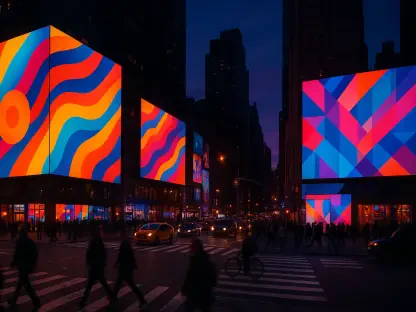
The rebirth of Out-of-Home advertising has been driven by a convergence of rapid digitalization and the integration of programmatic purchasing models. The transition from traditional static posters to high-tech digital screens has revolutionized the available inventory, allowing brands to deliver dynamic content and real-time updates that were previously impossible. This technological leap means that OOH is no longer a passive medium; it has become a flexible, high-performance channel that can react to environmental triggers such as weather changes, traffic conditions, or even live sports scores. Digitalization has essentially brought the agility of online advertising into the physical world, creating a hybrid space where massive physical scale meets surgical digital precision. This allows advertisers to maintain a consistent presence in the public square while still being able to pivot their messaging instantly based on evolving business needs.
Furthermore, the rise of programmatic buying in the physical world has introduced a level of efficiency and accountability that has historically been the domain of the digital sphere. Automated systems now allow planners to bid on OOH inventory with the same level of granular control they use for social media or search advertising. This data-driven approach allows for better optimization of budgets and ensures that messages are delivered to the right audience at the most opportune moments. However, despite these advancements, the primary strength of OOH remains its tangible presence in the real world. In an era where digital algorithms often isolate users into personalized bubbles, physical advertising occupies a common space that everyone shares. This unique characteristic allows OOH to act as a powerful tool for breaking through the noise of a fragmented media environment, providing a reliable touchpoint that anchors a brand’s identity in physical reality.
Cognitive Capture: The Science of Focus
Modern media strategy is increasingly leaning on neuroscience to navigate the critical distinction between simple exposure and genuine cognitive attention. While traditional industry metrics have long focused on opportunities to see, such as impressions and circulation numbers, neuroscience provides a deeper understanding of whether the human brain actually registers and processes a stimulus. In a high-speed urban environment, visibility does not always equate to attention; a consumer may pass dozens of advertisements without a single one leaving a lasting impression. Strategists are now utilizing research into visual field dynamics and brain processing power to design more effective campaigns. For instance, the position of an advertisement within a person’s line of sight and its contrast against the urban background are now recognized as critical factors in whether a message will be noticed or ignored by the subconscious mind.
Building on these scientific insights, the complexity of the creative message must be carefully calibrated to match the environmental context. A complex, text-heavy advertisement on a roadside billboard may be seen by thousands of drivers, but if the exposure time is only a few seconds, the brain will likely fail to process the information. Conversely, ads placed in environments with high dwell times, such as transit stations or elevators, can afford to be more detailed and narrative-driven. By focusing on how to earn the brain’s focus rather than just achieving high visibility numbers, brands can create more impactful encounters. This shift toward science-based planning ensures that the creative execution is not just artistic, but functional. It allows for the creation of campaigns that work in harmony with the way humans naturally perceive their surroundings, ultimately leading to higher recall rates and more effective communication of brand values.
Synergy Between Human and Artificial Intelligence
Interdisciplinary Synergy: Merging Art and Data
One of the most significant points of friction in the traditional advertising workflow has been the sequential nature of strategy, creative, and media departments. When these disciplines operate in isolated silos, the resulting campaigns often feel disjointed, as if the creative idea and the media placement were developed in two different worlds. To overcome this, the industry is moving toward a more collaborative approach where media and creative teams work together from the very inception of a project. In the context of OOH, this collaboration is particularly vital because the physical environment itself often dictates the effectiveness of the creative execution. When media planners and art directors sit at the same table early in the process, the media opportunity itself can often become the inspiration for the creative concept, leading to a much more cohesive and powerful brand presence.
This unified system also allows performance data to serve as a continuous feedback loop that informs both future strategies and creative directions. Instead of seeing the data as a report card that arrives after the campaign is over, teams can use real-time analytics to make adjustments on the fly. For example, if data shows that a particular creative version is resonating more strongly in certain urban contexts, the team can quickly reallocate resources to capitalize on that success. This level of agility ensures that every element of the campaign is optimized for the specific environment in which it lives. By breaking down the walls between departments, agencies can produce work that is not only visually stunning but also scientifically grounded and data-informed. This synergy between the art of persuasion and the science of distribution is what defines the most successful agencies in the current market.
Augmentation: Balancing Human Logic and AI
Artificial Intelligence has transitioned from a speculative technology into a massive amplifier of human productivity and intelligence within the media sector. In 2026, AI is utilized to handle the analytical heavy lifting that was previously impossible for humans to manage manually, such as the rapid analysis of vast datasets involving mobility patterns, audience demographics, and geolocation history. These tools allow planners to identify complex correlations and hidden trends that would take a human team weeks to discover. By automating the routine aspects of data processing and media optimization, AI frees up human professionals to focus on higher-level strategic thinking. The goal is not to replace the human element but to augment it, providing planners with the insights they need to make more informed decisions and take more calculated risks.
However, the limitations of Artificial Intelligence remain clear, particularly when it comes to the necessity of human judgment and cultural nuance. While an algorithm can identify the technically optimal placement for an advertisement based on historical data, it cannot deeply understand the unique soul of a brand or interpret the subtle social shifts of a city. AI lacks the ability to recognize when a technically perfect solution is strategically uninspired or when a brand needs to take a bold risk that defies historical patterns. The future of the industry lies in the partnership between human intelligence and artificial tools. Humans provide the empathy, the creativity, and the strategic vision, while AI provides the analytical scale and the processing power. This balance ensures that media strategies remain grounded in data without losing the human connection that is essential for building a lasting relationship between a brand and its audience.
Future Implications: Navigating the New Media Era
The overarching trend in the advertising world shifted toward a more holistic, data-informed, and scientifically grounded approach to communication. As agencies adapted to the realities of 2026, those that prioritized strategy over simple space-buying established themselves as the most valuable partners for corporate growth. The movement toward applied intelligence allowed brands to move beyond traditional transactional metrics and focus on creating genuine value in a complex world. By integrating neuroscience, advanced analytics, and interdisciplinary collaboration, the industry transformed OOH from a static medium into a dynamic, high-performance channel. This evolution proved that the physical world remains the most potent arena for brand building when supported by the right technological infrastructure and strategic vision.
Moving forward, professionals in the field must continue to refine their ability to blend technical expertise with human intuition. The next logical step for brands is to invest more heavily in proprietary data models that reflect the specific mobility patterns of their core customers rather than relying solely on third-party information. Agencies should also seek to deepen their partnerships with urban planners and technology providers to ensure that advertising becomes a more seamless and helpful part of the city environment. By focusing on the quality of the encounter and the specific business problem at hand, the industry will continue to thrive in an era of constant technological change. The success of future campaigns will depend on the ability to remain agile, stay grounded in business objectives, and always prioritize the strategic why over the operational how.