
When the elevator doors at Dundrum Town Centre open, the mechanical movement physically pulls the lead characters apart to mirror the show’s theme of separation. This sophisticated execution is the crown jewel of Sky’s recent marketing offensive for its original drama, a project that seeks to bridge the gap between digital content and the tangible world through a multi-layered Out-of-Home campaign throughout Ireland. Developed in close collaboration with Starcom, the initiative aims to generate significant public interest by making the series’ launch a visible, unavoidable part of the daily urban commute. Instead of relying solely on algorithmic suggestions or social media feeds, Sky has invested heavily in a physical presence that commands attention in high-traffic environments. The campaign utilizes a sophisticated blend of standard high-impact advertising formats and bespoke experiential installations, ensuring that the drama’s narrative of conflict is literally built into the architecture of the city’s most frequented retail and transit hubs today.
Dynamic Visuals and Narrative Tension
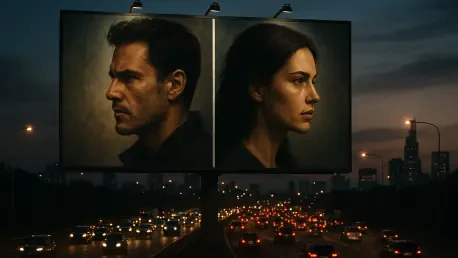
The central creative pillar of this initiative revolves around the provocative and direct tagline, “Take Sides. Take Everything.” This phrase serves a dual purpose, functioning as both a concise plot summary and a visual guide for the entire suite of advertising materials deployed across the region. Throughout the campaign, the artwork consistently features the series’ lead actors, Dominic West and Sienna Miller, who are positioned on diametrically opposing sides of the creative canvas. This spatial separation is far more than a mere aesthetic choice made by a design team; it is a literal and visceral representation of the conflict and interpersonal distance at the heart of the television show. By maintaining this consistent layout across diverse media, from digital screens to printed posters, Sky ensures that the core premise of the drama is communicated instantly to anyone passing by. This method turns every advertisement into a brief narrative snapshot that underscores the fundamental division between the two protagonists in their legal fight.
In every format utilized during this rollout, from the massive billboards lining major highways to the smaller displays found at transit stops, the design deliberately maintains a high level of narrative tension. By placing the title of the show, which is simply and boldly named “WAR,” squarely in the center of the artwork, the campaign forces the viewer to acknowledge the deep divide between the two main characters. This rigorous consistency across various media types ensures that regardless of where a consumer encounters the advertisement, the narrative of the series—which centers on a bitter and highly public divorce—is instantly recognizable. The psychological impact of seeing the word “WAR” acting as a barrier between the two leads cannot be understated, as it perfectly encapsulates the legal warfare that defines the eight-part drama. This strategic use of negative space and central typography creates a visual anchor that remains effective even when viewed at high speeds or in crowded environments.
The Power of Multi-Format Integration
The true effectiveness of this marketing push lies in its exceptional breadth and the variety of channels used to reach a wide demographic. Sky and its strategic partners have utilized a massive array of Out-of-Home formats to capture different audience segments throughout the course of their daily routines across the country. Large-format 48-sheet billboards were deployed to provide the campaign with the necessary scale and stature, ensuring the imagery was visible to motorists on major arterial routes. Meanwhile, eye-level 6-sheet displays were positioned in pedestrian-heavy zones and near public transit stops to bring the message closer to individuals who are on foot. Additionally, the use of T-sides on public buses allowed the campaign to achieve mobile reach, moving the branding through various residential neighborhoods and business districts. This diversified approach ensures that the series becomes a omnipresent part of the local landscape, reaching people at multiple touchpoints.
The logic behind this multi-format strategy is heavily supported by modern industry research which indicates that audiences are significantly more likely to engage with a brand when they encounter it across several different platforms simultaneously. Data provided by the PML Group regarding the Multi-Format Effect suggests that approximately 69 percent of individuals are more likely to notice an advertisement when it is integrated across diverse media environments. Furthermore, brand recall for these types of layered campaigns often indexes significantly higher than for those relying on a single-format strategy, sometimes exceeding them by more than forty points in standard tracking metrics. By saturating the urban environment with different types of media, Sky increases the likelihood of repeated exposure, which is absolutely critical for converting a casual observer into a dedicated series subscriber. This saturation creates a sense of ubiquity that digital-only campaigns often struggle to achieve in the modern world.
Experiential Marketing and Brand Activation
While the broader rollout provides the necessary reach and frequency, the absolute standout element of the entire project is the experiential execution located at Dundrum Town Centre. This specific location was chosen with great care, as it represents one of the highest-footfall retail environments in Ireland, providing a massive stage for high-impact brand interactions. In this bustling setting, the PML Group’s specialized Create team transformed a standard elevator into a sophisticated piece of interactive storytelling. This was not a simple wrap of the exterior, but a thoughtful integration of the show’s narrative into the physical movement of the building’s infrastructure itself. By selecting a location where thousands of people gather daily for shopping and leisure, Sky ensured that their most innovative creative asset would receive maximum visibility. The Dundrum takeover illustrates a shift in marketing where the medium is no longer passive but becomes an active participant in the story being told.
This specific elevator execution is a prime example of how modern advertising can move beyond static imagery to become a true brand activation. The creative work is not just sitting on top of the medium; it is fully integrated into the physical behavior and mechanical function of the elevator itself. The takeover even extends into the interior of the elevator cars, creating a fully immersive environment for passengers that reinforces the show’s high-stakes legal drama through subtle design cues. For the average shopper, this turns a routine and often boring act—waiting for and riding an elevator—into a memorable and potentially shareable encounter with the brand. This type of experiential marketing is designed specifically to trigger organic word-of-mouth and social media activity, further extending the reach of the campaign beyond those who actually visit the shopping center. It transforms a standard transit moment into a tactile manifestation of the show’s central themes of separation.
Strategic Context and Production Scale
The campaign serves as a massive support structure for the launch of the series, an eight-part legal drama created by the acclaimed George Kay. The story focuses on an estranged couple, portrayed by the talented Dominic West and Sienna Miller, whose high-stakes divorce spiraling out of control pulls two major London law firms into a complex and aggressive conflict. The prestige nature of the production is further underscored by the fact that it was commissioned for two seasons by both Sky and HBO, signaling a massive financial and creative investment in high-quality storytelling. This partnership between two major global broadcasters suggests a high level of confidence in the script and the performances, which the marketing campaign must accurately reflect. By emphasizing the drama’s scale through large-format outdoor media, the promoters are signaling to the audience that this is a premium viewing experience that warrants their undivided attention amidst a sea of content options.
For a broadcaster like Sky, a robust physical campaign serves a vital function in today’s extremely crowded streaming landscape. Digital advertisements and short social media clips can often be scrolled past or ignored by consumers who are increasingly suffering from digital fatigue and ad-blindness. In contrast, a physical campaign that includes massive highway billboards and interactive urban installations gives the production a distinct sense of “event” status that is hard to replicate online. It signals to the public that this is a major production worth their time, separating it from the hundreds of other titles available on various streaming platforms. By creating these physical landmarks, Sky successfully anchors the show in the real world, providing a sense of legitimacy and importance that helps it stand out. This approach acknowledges that while the product is digital, the audience lives in a physical world where scale and presence still matter immensely for brand perception.
Legacy of Interaction: Moving Beyond Static Media
The timing of this entire rollout was meticulously designed to build maximum momentum leading up to the series premiere. The drama officially debuted on the Sky network and the streaming service NOW on October 2, and the marketing efforts were synced to hit their peak exactly during this period. The Dundrum Town Centre activation launched just before the premiere to build early buzz among the public, while the wider campaign across billboards and buses went live on October 5 and continued through the middle of the month. This window of high-intensity activity ensured that the show remained visible during the critical first few weeks of its release, which is when most potential viewers make the decision whether to commit to a new multi-episode series. Strategic timing like this is essential for maximizing the return on investment for high-budget productions, ensuring that the initial wave of viewership is strong enough to sustain long-term interest and word-of-mouth.
The implementation of the campaign demonstrated how modern marketing should leverage physical environments to enhance narrative impact. By moving beyond traditional posters, the organizers established a new standard for interactive brand storytelling that effectively used urban infrastructure to mirror complex emotional themes. The success of the project suggested that future initiatives should prioritize multi-sensory experiences and strategic location placement to break through the noise of the digital age. Professionals in the industry noted that the integration of mechanical movement into the creative design provided a blueprint for future experiential activations in retail settings. Moving forward, the industry likely focused on refining these tactile engagements to further blur the lines between advertisement and entertainment. This project ultimately proved that even in an era dominated by digital platforms, the physical world remained an essential stage for capturing the collective imagination of a diverse and busy audience.