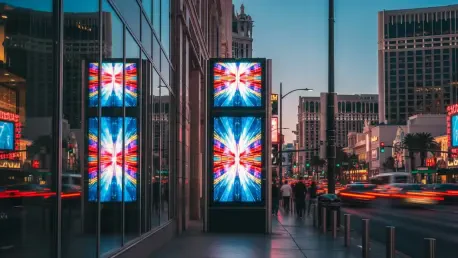

Walking down the four-mile stretch of Las Vegas Boulevard South today reveals a landscape where the classic neon glow has been effectively eclipsed by the pulse of high-resolution digital light. The transformation of the Las Vegas Strip from a collection of static billboards into a sophisticated, high-fidelity digital out-of-home (DOOH) network is fundamentally altering how brands communicate with a global audience. This stretch of road has long been a global advertising epicenter, but the recent push toward digital modernization has solidified its status as a laboratory for urban media. Key market players like Spotlight Outdoor and Vistar Media have been instrumental in this shift, moving away from high-altitude signage toward pedestrian-level infrastructure that interacts directly with the millions of visitors walking the sidewalk.
Central to this evolution is the conversion of the Touchdown Towers, a series of thirteen 38-foot structures that have been reimagined as digital beacons. This strategic overhaul is not a short-term experiment; it is backed by 20-year long-term agreements that provide a stable foundation for the city’s media landscape. These assets are no longer just passive holders for vinyl wraps but have become active participants in the digital ecosystem of the city. By focusing on eye-level engagement, advertisers are finding new ways to break through the traditional visual clutter that defines the Strip.
Emerging Trends and Data-Driven Growth in the Vegas Market
Technological Shifts and the Rise of Programmatic Delivery
As the market moves through the current cycle, the primary catalyst for change is the shift from traditional static inventory to flexible, real-time programmatic ad buying. This transition allows brands to launch campaigns in minutes rather than weeks, adjusting creative content based on time of day, weather, or specific events happening at nearby resorts. The integration of Screen Sync technology has further elevated this experience, enabling marketers to create immersive, synchronized brand takeovers where multiple towers across the Strip display coordinated content simultaneously.
Furthermore, the influence of the TikTok Generation has necessitated a shift in content strategy. Modern travelers are not just passive observers; they are content creators looking for visually striking backdrops for their social media feeds. By placing high-resolution digital screens at eye level, the network encourages pedestrian interaction and organic social sharing. This creates a secondary layer of reach as street-level advertisements are captured and distributed globally via mobile devices, effectively turning every passerby into a brand ambassador.
Performance Metrics and Projected Market Expansion
The economic viability of this digital shift is supported by staggering traffic data, with the Strip seeing approximately 419,000 daily pedestrian hours and 69,000 vehicular movements. These high-density figures serve as the catalyst for premium CPMs, as the volume of impressions far outweighs typical urban environments. The transition from the initial Triple Crown phase to the current All-In Network has demonstrated the scalability of the model, with phase-one assets alone already generating roughly 1.7 million weekly impressions.
Expansion plans are currently moving toward a potential 20-tower circuit, which would provide an unprecedented level of saturation along the Boulevard. This growth is fueled by data-driven insights that allow media owners to prove the value of their inventory with precise metrics. As the network grows, the ability to target specific visitor demographics—ranging from luxury shoppers at the Forum Shops to sports fans at the Allegiant Stadium—becomes increasingly refined, making the Las Vegas Strip one of the most measurable and effective advertising environments in the world.
Navigating the Technical and Environmental Obstacles
The physical environment of southern Nevada presents unique challenges that require high-specification hardware. To combat the extreme visual noise created by competing casino signs, the network utilizes 6-millimeter pixel pitch LED technology, which ensures that images remain sharp and legible even from just a few feet away. This level of clarity is vital for ground-level screens where the viewing distance is significantly shorter than for traditional high-rise billboards.
Managing the logistical complexities of a phased rollout in one of the busiest pedestrian corridors in the world requires careful coordination. For instance, installations at high-traffic intersections like Flamingo Road must be completed without disrupting the flow of thousands of tourists. Beyond installation, hardware durability is a constant concern; the equipment must maintain peak brightness and functionality while being subjected to the intense heat and UV radiation of the desert climate. Advanced cooling systems and weather-resistant casings are standard requirements to ensure these multi-million dollar investments remain operational around the clock.
Standards, Security, and Public Service Integration
The digital transition is also governed by complex regulatory and partnership models involving Clark County and various private landowners. Long-term property partnerships are essential, as they allow for the seamless integration of media assets into the existing architecture of the resorts. These relationships are often governed by revenue-sharing models that provide financial incentives for property partners and local government entities, creating a sustainable economic loop that benefits the broader community.
In addition to commercial interests, the DOOH network serves a critical dual purpose as a public service tool. Because the screens are managed through a centralized digital system, they can be instantly transitioned to display real-time public service announcements or emergency messaging. This capability provides Clark County with a direct line of communication to the public during critical incidents or for general crowd management during major events like New Year’s Eve or high-profile sporting competitions.
The Future of Urban Media: Automation and Global Influence
Looking at the trajectory of urban media, the influence of artificial intelligence and advanced data analytics will likely lead to even more hyper-targeted messaging for the 40 million annual visitors. AI-driven systems can analyze real-time crowd movement and sentiment to adjust advertising creative on the fly, ensuring that the message on the screen matches the mood and needs of the audience in that specific moment. This level of automation represents a departure from the one-size-fits-all approach of the past.
Another significant shift is the move toward non-exclusive ad inventory. Property-neutral networks are disrupting the traditional model where casinos exclusively controlled the media on their own land. This allows a diverse range of brands—from tech giants to beverage companies—to maintain a consistent presence across the entire Strip, regardless of which resort they are standing in front of. This model serves as a blueprint for other high-density tourist environments worldwide, such as London’s Piccadilly Circus or New York’s Times Square, where the integration of programmatic flexibility and premium physical placement is becoming the new gold standard.
Summary of the Las Vegas Advertising Revolution
The systematic conversion of the Las Vegas Strip’s advertising infrastructure marked a definitive turning point in the relationship between brands and urban spaces. By prioritizing eye-level strategy and social media amplification, the network successfully bridged the gap between physical signage and digital engagement. The synergy between sophisticated software stacks and premium physical placements allowed for a level of programmatic flexibility that was previously unattainable in such a high-stakes environment.
Moving forward, the industry needed to focus on the further integration of biometric data and interactive hardware to deepen the connection between the screen and the passerby. Brands that embraced this programmatic shift positioned themselves to capture the attention of a more transient and digitally-oriented audience. The success of this rollout suggested that the future of out-of-home advertising lay in the ability to deliver hyper-relevant content that felt like a natural extension of the pedestrian experience. Establishing standardized metrics for ground-level engagement remained the final hurdle for maximizing the ROI of these digital assets in the global market.