
In the world of digital marketing, few challenges are as nuanced as translating the whispered elegance of “quiet luxury” for the vibrant, accessible stage of social media. We sit down with Anastasia Braitsik, a global leader in SEO, content marketing, and data analytics, to explore how elite, Michelin-starred restaurants are navigating this delicate balance. Our conversation delves into the art of the “soft-sell,” where mystique is a key ingredient, and the strategic decision of what to reveal versus what to keep secret. We’ll also touch upon the potential pitfalls of new technologies like generative AI and look ahead at what the future holds for marketing in the pinnacle of the hospitality industry.
The “quiet luxury” model, common with brands like Chanel and Hermès, relies on subtle signals. How do high-end restaurants translate this exclusivity to social media, a platform built on accessibility? Please share some practical examples of how they balance mystique with online engagement.
That’s the central paradox, isn’t it? Social media is built for the masses—over four billion of them—while quiet luxury is for the few. The key is to use the platform not as a megaphone, but as a velvet rope. You’re not trying to shout at everyone; you’re trying to whisper to the right people. For example, instead of a post that says, “Come try our new winter menu,” a restaurant might post a single, stunning image of a hand-forged fork resting on a unique ceramic plate, with a caption that simply says, “Winter is coming.” There’s no food, no price, no call to action. It’s a signal, a visual cue that only those who appreciate that level of craftsmanship—the target audience—will truly understand. It makes them feel part of an exclusive club that “gets it,” preserving that cachet while still engaging online.
Many top restaurants favor a “show, don’t tell” marketing strategy. Could you walk me through the step-by-step process of creating a social media post that entices potential diners about a new dish without spoiling the surprise of its unique ingredients or flavor combinations?
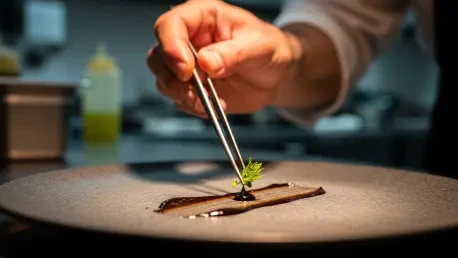
Absolutely. The process is one of strategic restraint. First, you start with the visual, but you capture only a fragment—perhaps an extreme close-up of a glistening sauce or the delicate edge of a single, perfectly prepared leaf. You avoid showing the entire composition. The goal is to hint at the artistry without revealing the full picture. Next comes the caption, which is where the real work happens. You completely avoid listing ingredients. Instead, you evoke a sensation or a concept. You might write something like, “A study in smoke and sea,” or “The forest floor after the rain.” This creates a flavor in the consumer’s mind, a sense of anticipation that leaves them speculating about what those combinations could possibly be. It’s an invitation to their imagination, ensuring the real discovery happens at the table, not on their screen.
Marketers often hype up a restaurant with “low-mystery” signals, like dish descriptions, while strategically holding back “high-mystery” elements like service and ambiance. How do they decide what to reveal versus what to conceal, and what are the key performance indicators for this approach?
The decision of what to reveal versus what to conceal is a calculated one, based on managing expectations and engineering a sense of wonder. The “low-mystery” signals, like a beautifully written description of a specific course, are the hook. They are tangible and easy to grasp, building initial excitement and desire. You reveal just enough to make someone want to book a reservation. The “high-mystery” elements—the seamless choreography of the service, the specific scent in the air, the way the light hits the glass—are strategically held back because these are the components that create true luxury. They can’t be adequately described; they must be experienced. The key performance indicator isn’t just clicks or likes; it’s the quality of engagement. Are people asking intrigued questions in the comments? Are they tagging friends with notes of aspiration? Ultimately, the real measure of success is a full reservation book and the sense of surprise and awe you see in customers when they finally arrive.
Generative AI tools offer a quick way to create content, but they could hinder a luxury brand’s allure. What specific pitfalls or mistakes could a restaurant make when using AI for its marketing, and how might this backfire and destroy the sense of anticipation for customers?
The biggest pitfall is the erosion of authenticity. Luxury is built on a unique, human-crafted story, and generative AI, by its nature, produces content based on existing patterns. A Michelin-star restaurant might use AI to write a caption and end up with something generic and soulless, like “Experience culinary excellence with our exquisite tasting menu.” That language is hollow and could apply to any fine dining establishment. It completely destroys the mystique. An even bigger mistake would be prompting AI to “create mystery,” as it could misinterpret the subtlety required and produce something that feels forced or cliché, which is the opposite of effortless elegance. This backfires immediately because discerning customers can sense the lack of a human touch. It makes the experience feel manufactured and cheapens the brand, completely dismantling the very anticipation you worked so hard to build.
What is your forecast for the future of luxury restaurant marketing?
I believe the future lies in a deeper, more artful integration of high-tech and high-touch. On one hand, we’ll see agentic AI used behind the scenes to design incredibly bespoke dining experiences, tailoring everything to a guest’s preferences before they even walk in the door. But on the marketing front, the “soft-sell” and the cultivation of “high-mystery” will become even more crucial as a counterpoint to our increasingly noisy digital world. The brands that succeed will be those that master the art of using technology to whisper, not shout. They will create digital breadcrumbs that lead to an unforgettable, real-world experience, proving that in an age of over-sharing, the greatest luxury of all is a well-kept secret.