
The Tangible Connection: Why Physical Presence Outperforms Digital Noise
In a landscape where digital saturation has reached an all-time peak, the ability for a brand to manifest physically within a consumer’s daily environment has become the definitive marker of success and authenticity. As audiences become increasingly desensitized to relentless online notifications and algorithm-driven social media feeds, the intrinsic value of physical interaction has never been higher. Recent market research indicates a significant shift in consumer sentiment, with nearly three-quarters of Americans expressing a clear preference for brands that engage them through local events and tangible community experiences. This trend underscores a broader movement away from screen-based marketing toward a world where physical presence serves as a critical bridge between brand discovery and measurable consumer action.
From Billboards to Experiences: The Evolution of Out of Home Advertising
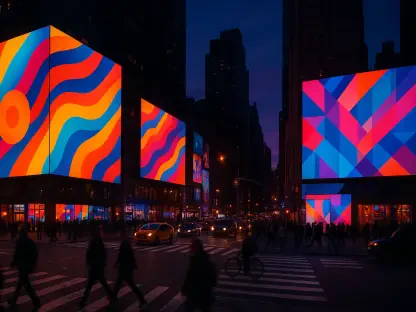
Historically, Out of Home advertising was categorized as a static medium, largely defined by highway billboards and transit posters designed for passive observation. However, the industry has undergone a massive transformation, shifting from mere visibility to high-level immersive engagement. This evolution was notably accelerated by a widespread sense of “digital fatigue,” as modern consumers began subconsciously filtering out intrusive online marketing tactics. Today, the landscape is dominated by retail-focused displays and live brand activations that integrate seamlessly into the consumer journey. Consequently, 69% of people now find these real-world advertisements more relatable than mobile alternatives, marking a departure from the perceived intrusiveness of digital platforms.
The Authenticity Factor: Why Being There Matters
Building Trust Through Immersive Brand Relatability
Establishing a genuine sense of authenticity remains one of the most formidable challenges for modern companies. Data suggests that 79% of consumers believe live product experiences make a brand feel more authentic, as physical interactions allow for a sensory evaluation that digital pixels simply cannot replicate. These “human” elements act as powerful differentiators in a crowded marketplace; approximately 64% of the population views physical-world advertisements as more culturally relevant than their online counterparts. By appearing in local neighborhoods or at specific community gatherings, brands transition from distant corporate entities into tangible components of a consumer’s lifestyle, fostering trust through shared physical space.
Driving Immediate Action Through Proximity and Timeliness
The effectiveness of real-world engagement peaks when it intersects directly with the consumer’s path to purchase. Research confirms that the impact of physical advertising increases dramatically when placements are situated inside a retail environment or immediately outside its doors. Such proximity triggers immediate behavioral shifts, with 73% of consumers willing to visit a store on the same day if an advertisement confirms product availability. Furthermore, 87% of individuals are likely to redeem time-limited offers encountered in the physical world. This creates a “bridge effect,” where a physical touchpoint acts as the final nudge required to convert interest into a transaction, often more efficiently than multiple digital reminders.
The Gen Z Craving for Physicality and Shared Experiences
A common misconception suggests that younger, “digital native” generations prefer purely virtual interactions, yet the opposite is increasingly true. Gen Z demonstrates a distinct longing for the physical world, with 71% of this demographic feeling they missed out on the in-person brand experiences enjoyed by previous generations. These younger consumers are highly observant of their physical surroundings, and 81% recall seeing recent outdoor advertisements. For brands, this represents an opportunity to leverage shared experiences; when a brand provides an immersive event, 40% of attendees make a purchase, and over a third amplify the message by sharing their experience across social networks, bridging the gap between the physical and the virtual.
The Future of Engagement: Integration and Hyper-Localization
The future of brand building resides in the convergence of physical presence and sophisticated data insights. The industry is moving toward a landscape where retail environments become increasingly personalized through hyper-localization, delivering specific messages based on the unique demographics of a street corner or a store aisle. From 2026 to 2028, the maturation of augmented reality is expected to further blur the lines between physical advertising and digital rewards. The strategic emphasis is shifting from broad-scale broadcasting to targeted invitations, where brands use the real world as a stage for high-value interactions rather than just a space for logo placement.
Strategies for Success in the Physical Marketplace
For businesses seeking to capitalize on these shifts, the strategy must move beyond traditional ad buying toward comprehensive experience design. Prioritizing proximity is essential; marketing efforts should be concentrated near the point of sale to capture shoppers already in a high-intent mindset. Additionally, offering value-driven incentives like product samples and free merchandise remains a primary draw for over half of the consumer base. Finally, focusing on the post-event journey is vital, as 30% of consumers search for more information after a physical interaction. Ensuring a smooth handoff from the physical encounter to a functional digital presence maximizes the total conversion rate of the campaign.
Reclaiming the Human Connection in Brand Marketing
The evidence was clear that real-world experiences formed the cornerstone of lasting brand loyalty. While digital tools provided reach, the physical world provided the depth and authenticity that consumers—especially the younger cohorts—demanded. By investing in physical engagement and live activations, brands successfully broke through the digital clutter to create moments that people actually noticed and remembered. In an environment that felt increasingly automated, the organizations that won were those that prioritized showing up in person where their customers lived and shopped. This strategic shift facilitated a deeper level of community trust and established a sustainable model for growth in the physical marketplace.