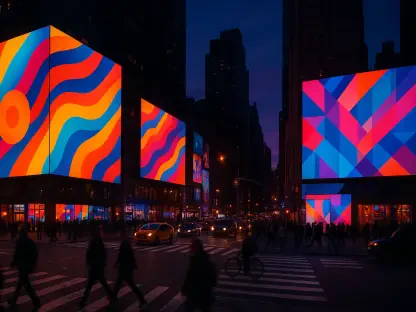

JD.com successfully utilized physical construction hoardings to create a sense of mystery and social buzz for an IKEA campaign in cities that lacked actual brick-and-mortar stores. This approach highlights a significant pivot in the Chinese marketing landscape, where the saturation of artificial intelligence has led to a noticeable decline in digital engagement. As generative tools flood social feeds with an endless stream of polished but often soulless imagery, consumers have begun to experience a profound sense of content fatigue. The “sea of sameness” generated by these automated systems has made it increasingly difficult for brands to stand out in a crowded online environment. Consequently, marketers are rediscovering the power of physical presence to cut through the digital noise. By grounding brand identities in a verifiable reality, these physical installations offer a level of authenticity that software-generated assets struggle to replicate. This move toward the tangible represents a strategic effort to capture fleeting attention spans by providing a sensory experience that feels inherently more trustworthy and reliable than the ephemeral content typically found on a smartphone screen.
Analyzing the Growth of Physical Media
Market Data: The Flight to Quality Eyeballs
Recent statistics from 2026 indicate a robust shift in media spending, with Out-of-Home advertising significantly outperforming the broader media market. While overall advertising growth in China has remained relatively modest, specific sectors like airport and high-speed rail advertising have seen double-digit increases. This trend suggests that top-tier brands are no longer satisfied with simply reaching a large number of users; instead, they are prioritizing “quality eyeballs” in environments where consumers are naturally separated from their mobile devices.
During travel, individuals are more likely to look up and engage with their surroundings, making them a prime target for high-impact visual messaging. This shift is particularly evident in major urban hubs, where the sheer volume of digital advertisements has rendered many online campaigns invisible. By investing in premium physical placements, companies can ensure that their messaging reaches an audience that is both attentive and psychologically prepared to absorb new information without the distractions of a social feed.
The Value of Interstitial Moments
One of the most compelling aspects of modern OOH advertising is its ability to dominate “interstitial moments.” These are the brief, often overlooked windows of time when a person is transitioning between activities, such as waiting for an elevator or standing on a subway platform. During these intervals, the human brain often seeks a temporary distraction from the monotony of waiting, but the psychological threshold for engaging with complex digital content is often too high. Physical advertisements in these spaces act as a low-friction source of information.
Unlike a targeted social media ad that might feel intrusive, an elegantly designed elevator screen or a creative bus wrap feels like a natural part of the urban landscape. By occupying these gaps, brands can communicate with consumers in a way that feels organic and non-threatening. This positioning allows for a subtle form of brand building that avoids the aggressive push-and-pull dynamics of algorithm-driven e-commerce platforms, providing a much-needed mental break from the relentless digital consumption that defines modern urban life.
Bridging the Gap Between Offline and Online
Creative Strategy: The Power of Social Currency
The most successful physical advertising campaigns in the current Chinese market are those designed specifically to be shared back into the digital world. This concept of “social currency” has transformed traditional billboards into immersive installations that serve as backdrops for social media content. For instance, recent “melting” billboard displays in Chongqing captured the public’s imagination by responding to the local climate in a visually stunning way. Passersby were not just observers; they became active participants by photographing the installation and sharing it.
This secondary digital life of a physical ad creates an exponential increase in reach that far exceeds the initial investment in the outdoor space. When a consumer chooses to share a brand’s physical installation with their own social circle, it acts as a powerful personal endorsement. This bridge between the physical and the virtual ensures that the brand remains relevant in both spheres, leveraging the authenticity of the real world to fuel the viral mechanisms of the internet in an era where consumers value peer-led recommendations above all else.
Technological Integration: Closing the O2O Loop
The effectiveness of these physical-digital hybrids is bolstered by China’s advanced infrastructure for Offline-to-Online (O2O) interactions. Consumers are deeply accustomed to using their smartphones to interact with the physical world through QR codes and NFC technology. Recent campaigns have integrated these “tap” points directly into elevator displays, allowing for immediate action. A consumer waiting for a lift can scan a code to receive a discount or be directed to a shopping app. This seamless transition allows brands to achieve trackability that was previously impossible.
In conclusion, the strategic resurgence of physical media provided a vital correction to the over-reliance on automated digital content. Marketing leaders established a sustainable advantage by grounding digital growth in the physical world. For future success, organizations should focus on developing “hybrid” assets that offer both physical impact and digital shareability. Moving forward, the focus must remain on authenticity, as the value of a verifiable brand presence will only continue to grow in an increasingly synthetic world. Brands that embraced high-traffic touchpoints maintained cultural relevance and built lasting trust.