
The sheer velocity of India’s digital integration has effectively dissolved the traditional boundaries between a billboard on a street corner and a personalized notification on a smartphone, creating a single, fluid ecosystem where nearly a billion people live and transact. As we navigate the current landscape, the Indian digital marketing sector is undergoing a profound structural transformation, moving away from the simplistic objective of merely established a digital presence toward the sophisticated orchestration of complex, multi-touchpoint consumer journeys. This evolution is characterized by a seamless convergence of media, commerce, and artificial intelligence into a singular, cohesive strategy that treats digital not as a separate vertical, but as the foundational layer of all modern communication.
The current environment represents a departure from the fragmented approaches of the past, as the industry enters an era where the “digital” label has become redundant because digital capabilities are now deeply embedded in every traditional medium. The significance of this shift is documented in recent collaborative analyses which suggest that the primary competitive advantage for brands in this market is no longer accessibility, but the ability to manage the interplay between data-driven insights and human-centric storytelling. Readers can expect an exploration of how the market has matured into a digital-majority economy, the explosion of rapid-delivery commerce, and the transition from static marketing funnels to dynamic, connected consumer loops that drive constant engagement.
Navigating the Structural Transformation of India’s Digital Economy
To comprehend the current state of the Indian market, one must first recognize the staggering scale of the digital infrastructure that supports nearly 1.3 billion mobile subscribers and approximately 960 million internet users. This massive connectivity has pushed internet penetration to 65%, creating a society where the distinction between online and offline life is increasingly academic. The sheer volume of users has fundamentally altered the financial landscape of the advertising industry, leading to a scenario where digital spending now accounts for more than 60% of total advertising expenditure. This milestone marks the definitive transition of India into a digital-majority economy, where the strategies once reserved for niche tech audiences are now the standard for reaching the mass market.
The historical context of this growth reveals a nation that bypassed many of the intermediate stages of technological adoption seen in Western markets, jumping straight into a mobile-first and now an AI-integrated reality. This rapid expansion was fueled by affordable data and a massive shift in consumer behavior, which has turned legacy formats like television and print into digitally delivered experiences. Television is no longer just a broadcast medium but is increasingly consumed through digital pipes such as Connected TV, while digital news platforms have absorbed the credibility and reach traditionally held by physical newspapers. Understanding this structural shift is vital for any brand because it explains why traditional marketing silos have collapsed in favor of a more holistic, platform-agnostic approach.
Furthermore, the rise of a robust middle class with significant purchasing power has created a digital consumption engine that shows no signs of slowing down. With 360 million online shoppers and 200 million users regularly engaging with Connected TV, the market has reached a critical mass that justifies massive investments in localized content and sophisticated data analytics. These background factors are not merely statistics; they are the bedrock of a new marketing philosophy that prioritizes real-time responsiveness over long-term static planning. The current progress of the economy suggests that the integration of digital services into daily life will only deepen, making the mastery of these digital foundations an absolute necessity for commercial survival.
Redefining Commerce and Consumer Journey Frameworks
The Explosive Growth of Retail Media and Quick Commerce
A critical aspect of the current playbook is the blurring line between product discovery and the final purchase, a phenomenon driven by the meteoric rise of Retail Media and Quick Commerce. Retail media has evolved from simple on-site banner advertisements into a powerhouse discipline that represents nearly a fifth of all digital advertising spend in the country. Major e-commerce platforms have transformed into sophisticated search engines and data repositories, allowing brands to target consumers at the exact moment they express purchase intent. This shift has forced marketers to reconsider their budget allocations, as the proximity to the point of sale often yields a higher return on investment than traditional awareness-based campaigns.
Simultaneously, the revolution in rapid delivery, or quick commerce, is reshaping the expectations of the urban consumer by growing at a rate of 50% annually. This sector caters to immediate, high-frequency needs, creating a unique advertising sub-sector where “retail readiness” is the most important metric for success. In this high-speed environment, having a creative advertisement is useless if the product is out of stock or cannot be delivered within minutes. Consequently, brands are now required to integrate their supply chain data with their marketing efforts, ensuring that their promotional activities are perfectly synchronized with local inventory levels and delivery capabilities.
Analyzing these trends reveals a market where two distinct types of shopping behaviors coexist: high-value planned purchases on traditional marketplaces and instant gratification through rapid delivery apps. Each requires a different strategic approach, yet both rely on the underlying power of retail media to capture attention. The challenge for modern businesses lies in balancing these two speeds of commerce while maintaining a consistent brand voice. This duality emphasizes that the marketplace is no longer a destination but a continuous presence in the consumer’s pocket, necessitating a 24/7 approach to retail visibility and logistical excellence.
Transitioning from Linear Funnels to Connected Loops
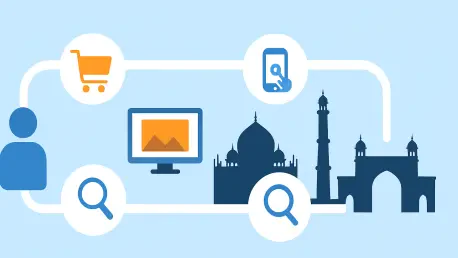
Building on the convergence of commerce and media, the industry is moving away from the traditional linear marketing funnel in favor of a non-linear, always-on loop. The legacy model of awareness leading to interest, desire, and finally action is no longer sufficient to describe the complex path of a modern Indian consumer. Instead, the journey is a continuous cycle of discovery, evaluation, trust, and conversion that happens across a multitude of touchpoints. A consumer might discover a product via a social media creator, evaluate it through an AI-powered search engine, build trust by reading user reviews on a marketplace, and finally execute the purchase on a delivery app, only to start the cycle again as they share their own feedback.
To navigate this complexity, marketers must integrate Paid, Owned, and Earned media into a single, unified system rather than treating them as separate departments. Paid media acts as the initial spark or accelerator for visibility, while owned media platforms like brand apps and websites provide the controlled environment necessary for deep engagement and data collection. Earned media, consisting of reviews, social mentions, and word-of-mouth, serves as the critical layer of social proof that validates the consumer’s decision. The loop framework highlights the inherent risk of fragmented marketing; a high-budget paid campaign will inevitably fail if the earned reputation of the product is poor or if the owned digital experience is frustrating.
This holistic view of the consumer journey requires a shift in how marketing success is measured, moving toward metrics that capture the lifetime value and the interconnectedness of different channels. By focusing on the loop, brands can create a self-sustaining ecosystem where every interaction feeds into the next, reducing the cost of customer acquisition over time. The transition to this model also acknowledges that the consumer is an active participant in the brand story rather than a passive target. This shift emphasizes that modern marketing is less about shouting a message at an audience and more about facilitating a continuous, value-driven conversation that spans multiple digital and physical environments.
The Revolution in Video Consumption and AI-Powered Search
Beyond the purchase journey, significant disruptions are occurring in how consumers find and watch content, particularly through the rise of “screen planning.” The industry has moved past the era of traditional TV planning, as the distinction between broadcast television and digital video continues to vanish with the proliferation of Connected TV. Brands must now consider the total screen exposure of a consumer, following them from the small screen of a mobile device during the day to the large format of a smart TV in the evening. This necessitates a more fluid approach to creative production, where content must be optimized for different aspect ratios, attention spans, and interaction levels across various devices.
A parallel revolution is taking place in the world of search, where traditional search engine optimization is being challenged by the emergence of Generative Engine Optimization and Answer Engine Optimization. As AI-powered search begins to command a significant portion of the market, the goal for brands is shifting from ranking first on a list of blue links to being the primary cited source in a synthesized AI response. This transition requires a new focus on authority, clarity, and the ability to provide direct answers to complex, conversational queries. Misconceptions about search visibility are being debunked as marketers realize that appearing in an AI’s spoken or written answer requires a different technical and content strategy than traditional keyword-based approaches.
Addressing these shifts is crucial for staying relevant in a future dominated by voice and AI-driven interactions. The rise of visual search and augmented reality further complicates the landscape, as consumers increasingly use their cameras to identify products and seek information in real-time. Brands that successfully navigate these changes are those that treat search not as a static destination but as a dynamic, AI-assisted assistant for the user. By optimizing for these new engines, companies can ensure they remain at the forefront of the consumer’s mind, regardless of the platform or the method used to find information.
Anticipating the Future: AI as the Marketing Operating System
Looking at the trajectory from 2026 to 2028, artificial intelligence has solidified its position as the central operating system for the entire marketing stack. The technology has evolved far beyond basic generative tools for text and images, moving into the realm of “Agentic AI.” These are autonomous systems capable of observing market signals, making high-level strategic decisions, and executing complex media buying tasks without constant human intervention. The potential for AI to manage hyper-personalization at a scale of hundreds of millions of individual users is now a reality, allowing for real-time creative adaptations that resonate with specific cultural and regional nuances across the diverse Indian landscape.
Technological advancements are also coinciding with significant regulatory shifts, most notably the implementation of India’s Digital Personal Data Protection framework. This legal environment is forcing a rapid move toward first-party data strategies, as the reliance on third-party cookies and intrusive tracking becomes a liability. Brands are now investing heavily in building direct relationships with their customers through loyalty programs, proprietary apps, and interactive content to gather data ethically. The future belong to organizations that can balance high-tech automated execution with a deep respect for consumer privacy, ensuring that personalization does not cross the line into intrusion.
Experts predict that the next few years will see a resurgence of the “brand-plus-performance” model, where the efficiency of AI-driven performance marketing is balanced by long-term investments in brand equity. While algorithms are exceptionally good at capturing existing demand, they cannot yet replicate the human ability to create new demand through emotional resonance and cultural relevance. As a result, the strategic focus is shifting toward using AI to handle the heavy lifting of data processing and media optimization, freeing up human creators to focus on the high-level strategy and empathy that define iconic brands. This period of progress will likely see the emergence of new marketing roles that bridge the gap between data science and creative storytelling.
Strategic Takeaways for the 2026 Digital Landscape
The current analysis of the digital marketing landscape provides several clear and actionable strategies for businesses looking to maintain a competitive edge. First and foremost, professionals must prioritize the collection and management of first-party data. In a privacy-centric world, the ability to understand and reach your own audience without relying on external intermediaries is the most valuable asset a brand can possess. This involves not just technical implementation but also a value exchange where consumers feel comfortable sharing their information in return for a better, more personalized experience. This approach ensures that marketing efforts remain effective even as global privacy standards continue to tighten.
Second, the methodology for measuring marketing success must evolve toward “incrementality” and sophisticated modeling. Relying on last-click attribution—which gives all the credit for a sale to the final ad a user saw—is no longer an accurate way to judge performance in a multi-touchpoint “loop” journey. Advanced marketing mix modeling allows companies to determine the true value of each activity, identifying which efforts are actually driving new sales and which are simply claiming credit for consumers who were already planning to buy. Applying these rigorous measurement standards helps in optimizing budgets and avoiding the trap of over-investing in low-value digital signals.
Finally, brands must adopt a holistic and integrated view of the consumer experience by ensuring that retail media, search optimization, and video content work in tandem. The siloed approach where social media, e-commerce, and traditional advertising operate independently is a recipe for inefficiency in the current Indian market. Instead, organizations should reorganize their teams around the consumer journey, ensuring that every touchpoint reinforces the others. By leveraging the scale of India’s digital infrastructure and the intelligence of modern AI tools, businesses can create a seamless and persuasive presence that guides the user from the first moment of discovery to a loyal, repeat relationship.
The Human Element in an AI-Augmented Future
The transition of the Indian economy into a digital-majority state revealed a fundamental truth about the nature of modern commerce: as execution became more automated, the value of human intuition significantly increased. The industry reached a point where algorithms handled the complexities of media buying and real-time optimization with superhuman efficiency, yet these tools ultimately required a human hand to provide a moral compass and strategic direction. Marketers learned that while AI could predict what a consumer might do next based on past data, it could not easily anticipate the sudden shifts in cultural sentiment or the deep emotional needs that drive brand loyalty. Consequently, the most successful organizations were those that treated technology as an enhancer of human creativity rather than a replacement for it.
The analysis of this era showed that the focus of marketing shifted from the mechanics of delivery to the quality of the message and the ethics of the data used to power it. New insights emerged regarding the importance of empathy and cultural sensitivity in a market as diverse as India, where a single automated campaign could easily miss the nuances of regional languages and traditions. The strategic takeaway from this period was the realization that the “New Marketing Stack” was a blend of high-tech infrastructure and high-touch strategy. Moving forward, the priority for any professional in this field was to master the powerful AI tools at their disposal while simultaneously cultivating the uniquely human skills of strategic judgment, ethical oversight, and imaginative storytelling. This balanced approach ensured that the digital economy remained a space for genuine connection between brands and the billion connected users they served.