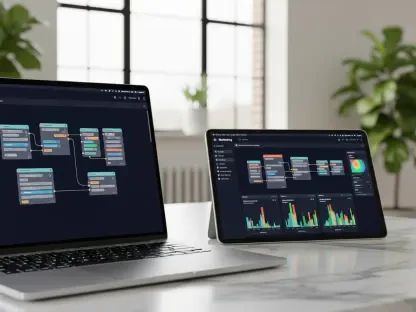

The resurgence of retail marketing budgets is not merely a return to form but a fundamental reshaping of strategy, where success is measured not by the volume of spending but by the intelligence of its application. As the industry moves past economic uncertainty, the retailers poised for dominance are those who recognize that the most valuable real estate is no longer just the shelf but the seamless connection between a customer’s digital life and their physical world. This transformation is being powered by an unprecedented investment in marketing technology (martech), turning static stores into dynamic, data-rich environments.
The Great Disconnect: Unpacking Today’s Fragmented Retail Landscape
For years, a stark division has defined the retail experience, with customers navigating a sophisticated ecosystem of personalized recommendations, targeted ads, and frictionless checkout processes online. In contrast, the physical store has often remained a technological backwater, relying on analog methods that feel disconnected from the digital journey. This chasm between a hyper-responsive online world and a static in-store reality creates a fragmented and often frustrating experience for the modern consumer, undermining brand loyalty and leaving valuable data on the table.
This digital-physical gap manifests differently across various retail sectors. In grocery, for instance, the inability to dynamically update pricing or promotions on shelves leads to missed opportunities and operational inefficiencies. Fashion retailers struggle to translate the rich, personalized experience of their websites to the fitting room, where staff have little insight into a customer’s online browsing history. Meanwhile, electronics stores, which should be beacons of innovation, often fail to use in-store technology to provide the deep product information and comparison tools that customers have come to expect online.
At the heart of this stagnation lies a dependence on legacy technology. Outdated point-of-sale systems that cannot integrate with modern CRM platforms, manual inventory tracking that leads to stockouts, and static printed signage that is costly and slow to update all act as anchors, preventing retailers from achieving the agility needed to compete. These systems were built for a different era, one where data was a byproduct of a transaction rather than the driving force behind the entire customer relationship.
This technological fragmentation is mirrored by organizational silos. Brand marketers, focused on digital campaigns and top-of-funnel awareness, often operate in a world separate from store operations teams, who manage the day-to-day realities of the physical floor. Bridging this divide is the IT department, which is frequently tasked with maintaining disparate systems that were never designed to communicate. The result is a lack of a unified vision, preventing the creation of a cohesive customer experience that flows effortlessly between online and offline channels.
The 2026 Turning Point: Forecasting a Tech-Fueled Retail Renaissance
Bridging the Phygital Divide: The In-Store Tech Revolution
The primary market driver fueling this retail renaissance is the imperative to merge the physical and digital, a trend often called “phygital.” Retailers are finally treating their physical stores not as isolated sales channels but as integral, data-generating nodes in a larger, interconnected customer journey. The goal is no longer to simply sell products in a store but to create a holistic brand experience that is consistent, personalized, and engaging, regardless of the touchpoint.
This shift is a direct response to evolving consumer expectations. Today’s shoppers do not see a distinction between a brand’s app, its website, and its physical location; to them, it is all one brand. They expect the convenience of online shopping—such as personalized offers, instant access to product information, and seamless payments—to be available in the physical world. Retailers who fail to meet this expectation risk being perceived as outdated and inconvenient.
To meet these demands, a new generation of in-store martech is being deployed. Interactive kiosks provide endless-aisle capabilities and detailed product information, while dynamic digital signage allows for real-time updates to promotions and branding. Internet of Things (IoT) sensors gather anonymous data on foot traffic and dwell time, providing insights into store layout and product placement. Furthermore, integrated mobile loyalty apps can recognize a customer upon entry, delivering personalized discounts and enhancing the shopping experience.
By the Numbers: Quantifying the Impending Martech Boom
The strategic pivot toward technology is reflected in market-wide investment trends. Industry forecasts point to a 6.3 percent rise in global advertising sales, signaling renewed confidence and a willingness to invest in growth. This rebound is not an indiscriminate return to traditional media but a calculated allocation of resources toward more measurable and effective channels.
More telling, however, is the explosive growth within the martech sector itself. The market is projected to expand by 20 percent to a valuation of $669 billion, a clear indicator that marketing leaders are prioritizing technology that delivers efficiency, personalization, and data-driven insights. This is not just a budget increase; it is a strategic reallocation of capital toward building a more intelligent and responsive marketing infrastructure.
Consequently, the metrics defining success are also evolving. Simple transactional data, such as daily sales, is no longer sufficient. Leading retailers are now focusing on more sophisticated performance indicators that provide a holistic view of customer health and marketing effectiveness. These include customer lifetime value (CLV), which measures the total worth of a customer over time; in-store engagement rates, captured through sensors and app usage; and multi-touch attribution models that accurately assign credit to both digital and physical touchpoints in the path to purchase.
Navigating the Headwinds: Overcoming Integration and Budgetary Hurdles
While the vision of a unified retail experience is compelling, the path to achieving it is fraught with technical challenges. The most significant hurdle is the integration of new in-store technologies with existing legacy systems. Connecting a modern CRM, an e-commerce platform, and a network of in-store IoT devices into a single, seamless data pipeline is a complex undertaking that requires significant technical expertise and strategic planning.
In a post-recession climate, budgetary constraints remain a major consideration for many marketing teams. However, strategic martech investments can offer significant long-term savings and a strong return on investment. For example, replacing recurring print and distribution costs with a one-time investment in digital signage allows for infinite, instantaneous campaign updates at a fraction of the long-term cost. Prioritizing scalable, high-impact solutions is key to modernizing on a lean budget.
This technological shift also creates a demand for new skills within marketing teams. The modern retail marketer must be as comfortable analyzing in-store foot traffic data as they are managing a social media campaign. This has created a talent and skills gap in the industry, forcing organizations to invest in training and development. Expertise in data analytics, technology implementation, and cross-channel strategy is no longer a niche specialty but a core competency for any successful marketing department.
The Privacy Imperative: Data Governance in a Unified Retail World
The collection of in-store customer behavior data introduces a new layer of complexity regarding data privacy. Global regulations like the General Data Protection Regulation (GDPR) and the California Consumer Privacy Act (CCPA) have established strict rules governing how personal data is collected, stored, and used. Retailers must ensure that their in-store data collection practices, whether through Wi-Fi tracking or loyalty apps, are fully compliant with these evolving laws.
Building and maintaining customer trust is paramount. This requires a commitment to transparency, with clear and accessible privacy policies that explain what data is being collected and how it will be used. The technology itself must be secure by design, with robust safeguards to protect sensitive customer information. Any failure in this area can lead to significant reputational damage and legal penalties.
Furthermore, the proliferation of connected devices in a retail environment creates new cybersecurity vulnerabilities. A network of IoT sensors, digital screens, and POS systems represents a broad attack surface for potential threats. Retailers must implement comprehensive security measures, including network segmentation, regular software updates, and intrusion detection systems, to protect their integrated platforms and maintain the integrity of their data.
Beyond 2026: The Future of Hyper-Personalized, Data-Driven Retail
Looking ahead, the role of artificial intelligence in analyzing retail data will become even more pronounced. AI-powered analytics engines will move beyond simple descriptive metrics to predictive modeling, allowing retailers to anticipate purchasing patterns and automate personalization in real time. This could manifest as a dynamic promotion on a digital screen tailored to the specific customer standing in front of it or inventory being automatically rerouted to a store based on predicted local demand.
In this new landscape, digitally-native brands and agile retailers who have mastered the phygital experience will emerge as significant market disruptors. Their ability to leverage a unified data ecosystem to create hyper-personalized and frictionless experiences will give them a powerful competitive advantage over slower, more traditional competitors who remain tethered to siloed operations and legacy technology.
The ultimate vision is a fully responsive retail environment, a store that is as dynamic and adaptable as a webpage. Imagine a space where lighting, music, and even layout can change based on the time of day, the demographic profile of the shoppers present, or even real-time weather data. Promotions would adapt instantly based on inventory levels, and the entire experience would be tailored to the individual, creating a truly one-to-one relationship between the brand and the customer.
The Strategic Playbook: Your Roadmap for the 2026 Rebound
The ongoing marketing rebound has been fundamentally defined by a strategic shift toward technology, not just a simple increase in spending. This transformation has been driven by the need to close the long-standing gap between sophisticated digital ecosystems and traditional, static in-store experiences. The retailers who thrived were those who embraced martech to create a single, cohesive customer journey.
For marketers preparing for the next phase of growth, the path forward required a focus on building a two-way data ecosystem where insights from online behavior informed the in-store experience and vice versa. This necessitated a move away from siloed thinking and toward a holistic strategy that treated all channels as part of a unified whole.
The most successful investments were in technologies that directly bridged the physical-digital divide and delivered a clear, measurable return. Dynamic digital signage, integrated mobile loyalty programs, and AI-powered analytics proved to be the cornerstones of the modern retail marketing stack. By prioritizing these areas, leading brands have not only navigated the rebound but have also built a more resilient, data-driven foundation for sustained future growth.