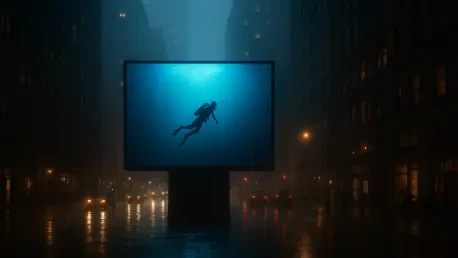

Positioning the Whalefall billboard at the natural line of sight for people walking past subway entrances effectively places the viewer underwater with the film’s protagonist Jay Gardiner. This tactical maneuver by the marketing team transforms a standard commute into an immersive encounter with the abyss, mirroring the claustrophobic survival narrative directed by Brian Duffield. As New Yorkers navigate the relentless pace of Manhattan, they are suddenly confronted with the harrowing reality of a diver trapped inside a sperm whale, a concept that demands immediate attention and emotional engagement. The campaign avoids the clutter of traditional high-rise advertising, opting instead for a physical presence that disrupts the urban flow. By anchoring the film’s release in the tangible world of concrete and steel, the promoters have bridged the gap between cinematic fiction and reality. This approach ensures that the high-stakes journey starring Austin Abrams and Josh Brolin resonates with a distracted audience.
Translating Narrative Tension Into Visual Minimalism
The creative engine of the Whalefall campaign relies on a minimalist philosophy that is essential for cutting through the visual density of a major metropolis like New York. The film’s narrative follows a diver’s desperate fight for life inside the gut of a whale, a premise that could easily be lost in a complex explanation. Instead, the billboards distill this ninety-minute experience into a singular, haunting visual moment that prioritizes mood over exposition. By utilizing murky underwater aesthetics and a somber color palette, the advertisements trigger an instinctive sense of dread in the observer. This strategy proves that in the realm of high-tension thrillers, the most effective marketing often leaves the details to the imagination. The sheer scale of the film’s title, rendered in bold and stark typography, ensures that the branding remains legible from blocks away. It bypasses the need for long-winded taglines, opting for a visual language that communicates immediate danger.
Central to this psychological approach is the “Hold Your Breath” tagline, which serves as a literal nod to the protagonist’s dwindling oxygen and a metaphorical command to the passing public. On a fast-moving Manhattan sidewalk, where pedestrians are constantly bombarded by bright screens and loud noises, this imperative phrase acts as a psychological anchor. It forces a moment of reflection and prompts the individual to connect with the physical sensation of breathlessness. The use of deep blue tones creates a stark contrast against the gray concrete and harsh artificial lights of the city surroundings, making the advertisement feel like a window into another world. This creative choice is not merely aesthetic; it is a tactical effort to disrupt the routine of the daily commute. By inviting the audience to participate in the film’s tension before they even purchase a ticket, the campaign builds a level of anticipation that digital trailers often struggle to replicate effectively.
Strategic Integration Into the Urban Pedestrian Experience
A tactical shift in this campaign is the deliberate move away from traditional elevated billboards toward eye-level street furniture and transit displays. By positioning the creative assets at the same height as the pedestrians walking past them, the campaign enters the personal space of the urban consumer. Unlike high-rise displays that require a conscious effort to look upward, these placements integrate the film’s imagery into the natural line of sight for those entering subways or navigating busy street corners. This proximity makes the imagery of the diver feel significantly more immediate and intimidating. It creates a sense of scale where the whale’s presence feels massive and overwhelming to the viewer standing just inches away from the glass. This physical closeness ensures that the film’s claustrophobic atmosphere is communicated effectively, transforming the street into a part of the cinematic experience. It is a sophisticated use of geography to enhance the overall marketing impact.
The urban environment of New York City provides a unique backdrop that heightens the effectiveness of the visual work through a powerful sense of cognitive dissonance. There is an inherent tension created by the juxtaposition of a crowded, air-filled city street against an advertisement that screams breathlessness and isolation. While the pedestrian is surrounded by the familiar sounds of traffic and the presence of thousands of people, the billboard presents a world of silence and solitary survival. This contrast ensures that the campaign does not simply blend into the background but instead functions as a distinctive visual event that demands a pause. The strategic placement ensures that the film’s primary themes are felt on a subconscious level. By the time a potential viewer considers going to the theater, they have already experienced a micro-moment of the film’s high-pressure environment. This creates a lasting impression that persists long after the person has moved through the intersection.
Modern Trends in Experiential Entertainment Marketing
The Whalefall campaign mirrors a broader shift in the entertainment industry toward “feeling-based” marketing strategies that prioritize emotion over plot. In an age where audiences are often oversaturated with detailed plot summaries and spoilers, marketers are finding success by selling a specific vibe or visceral reaction. For a survival thriller, the raw fear of the unknown and the pressure of a ticking clock are the primary selling points. This campaign demonstrates a consensus among industry leaders that fostering a sense of curiosity through atmosphere is more effective than explaining character arcs. By focusing on the basic human instinct for survival, the advertisements appeal to a universal audience regardless of their familiarity with the source material. This approach acknowledges the reality of short attention spans in the digital era, offering a high-impact visual that can be understood in a matter of seconds. It prioritizes the “how” of the experience over the “what” of the story.
Furthermore, the use of physical outdoor advertising in a major cultural hub like New York provides the film with a sense of real-world legitimacy. In an era where digital algorithms and streaming platform menus dominate how people discover new content, seeing a massive, tangible advertisement during a daily commute signals that a project is a significant cultural event. It serves as a persistent physical reminder of the theatrical release, catching consumers during their social outings and daily routines in a way that a fleeting smartphone notification cannot. This physical presence creates a level of brand authority that is difficult to achieve through social media alone. For a film like Whalefall, being visible in the physical geography of the city reinforces its status as a must-see cinematic experience. The persistence of the billboard—remaining in the same spot day after day—builds a cumulative awareness that eventually translates into box office action for the studio.
Synchronizing Media Placement With Release Urgency
The success of the Whalefall NYC campaign was largely due to its ability to synchronize high-impact media placement with the urgency of the film’s opening day. By launching these visceral visuals in tandem with the theatrical release, the marketing team created a ticking-clock atmosphere that encouraged immediate consumer action. This strategy moved the audience from a state of simple awareness to a potential ticket purchase within a single, high-tension visual encounter. The presence of established Hollywood talent like Josh Brolin further reinforced the film’s authority, positioning it as a premium event within the competitive landscape of the season. The timing of the rollout was critical, as it leveraged the buzz of premiere reviews and social media trends to drive physical foot traffic toward theaters. This alignment between digital sentiment and physical advertising represents a holistic approach to film promotion that maximizes the return on high-cost outdoor media investments.
Looking forward, studios should consider how eye-level immersion can be utilized to break through the noise of digital saturation. The Whalefall campaign proved that physical space remains a potent tool for narrative storytelling if it is integrated thoughtfully into the urban fabric. Marketers demonstrated that visceral, site-specific interactions can ensure maximum impact in high-traffic areas. This shift toward grounded, atmospheric advertising suggests that future promotional efforts should prioritize the physical sensation of a film’s world. By turning a city street into an extension of the cinematic screen, brands can create memorable experiences that outlast a typical digital ad cycle. Moving into 2027 and 2028, the industry should look to these street-level tactics as a blueprint for high-concept genre films. This approach successfully turned a standard billboard into a narrative portal, making the theatrical launch a visible and unavoidable part of the landscape.