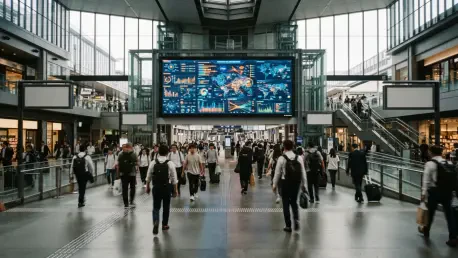

By leveraging Singapore’s extensive public transport infrastructure, Tiger Brokers is now delivering live financial market updates directly to commuters through intelligent digital displays. This landmark collaboration among Stellar Ace, Adzymic, and Tiger Brokers has officially introduced Asia’s first “agentic” out-of-home advertising campaign, marking a definitive shift in how brands occupy physical spaces. While the industry has long experimented with digital screens, this move represents a qualitative jump from simple programmatic scheduling to a system that possesses genuine agency. In the bustling transit hubs and commercial centers of Singapore, the traditional static billboard has been replaced by a responsive ecosystem capable of interpreting complex market signals. This initiative does not merely present information; it creates a living dialogue between the financial markets and the public during their daily commute. By integrating these advanced capabilities, the partnership has established a new benchmark for urban engagement that prioritizes relevance and immediacy over repetitive broadcasting. As the project rolls out across various high-traffic locations, it demonstrates the maturation of smart-city infrastructure in 2026, where the boundary between digital trading platforms and physical environmental media becomes increasingly fluid and interconnected. This transition ensures that brand messages are no longer just passive background noise but are intelligently delivered to the right audience at the most opportune moments, effectively transforming the urban landscape into a highly responsive digital environment.
The Mechanics of Goal-Oriented AI Agency
The fundamental innovation driving this campaign is the departure from traditional automation in favor of agentic systems that exhibit autonomous reasoning. Unlike standard programmatic digital out-of-home platforms that follow a rigid, prewritten script based on simple triggers like time or weather, agentic AI is designed to achieve specific high-level goals. These AI agents possess the capability to ingest vast amounts of data and make real-time decisions regarding which creative execution will perform best in a specific context. This means the system does not just wait for a trigger; it actively seeks out the optimal way to fulfill its objective, whether that is maximizing audience engagement or ensuring the most relevant financial ticker is visible during market volatility. By operating without constant human oversight, the technology can react to shifts in the environment faster than any manual team could ever achieve. This shift toward “agency” allows the advertising content to maintain a level of urgency and precision that was previously only available in the private, hyper-personalized realms of social media feeds or mobile applications, now brought into the public sphere on a massive scale.
Furthermore, these agentic systems utilize advanced logic to evaluate multifaceted environmental variables simultaneously, including localized foot traffic patterns and audience density provided by the transit network. Instead of cycling through a fixed loop of advertisements, the AI agent assesses the immediate surroundings and selects the most effective creative version for any given second. For example, during a sudden surge in market activity on the Singapore Exchange, the agent can prioritize urgent financial news or specific stock updates that align with the interests of the tech-savvy demographic present at that moment. This level of responsiveness transforms the physical screen into a data-responsive asset that functions more like a professional advisor than a traditional advertisement. The capability for autonomous decision-making ensures that the content remains fresh and contextually aware, providing a seamless user experience that bridges the gap between the physical world and the digital economy. This technological leap reflects a broader trend in 2026 where artificial intelligence is moving beyond backend processing and into frontline, consumer-facing roles that require sophisticated reasoning and real-time execution.
Strategic Contributions of the Core Partners
The success of this groundbreaking initiative is built upon a trifecta of industry expertise that combines physical infrastructure, cutting-edge technology, and a forward-thinking brand vision. Stellar Ace, acting as the media arm of SMRT, provides the essential physical canvas for this campaign through its extensive network of digital screens strategically placed across Singapore’s premier transit hubs, shopping malls, and public spaces. Their infrastructure serves as the backbone of the project, offering the necessary reach to capture the attention of millions of commuters daily. By opening up their digital network to agentic technology, Stellar Ace has moved beyond being a mere provider of screen time and has instead become a facilitator of intelligent urban communication. Their ability to provide localized data on foot traffic and audience movement is a critical component that allows the AI agents to function effectively, ensuring that the physical environment is as data-rich as any online platform. This collaboration highlights the vital role of modern transport networks in the evolution of smart-city advertising.
Complementing this infrastructure is the intellectual engine provided by Adzymic, a leader in ad-tech specializing in Dynamic Creative Optimization. Adzymic’s proprietary technology acts as the brain of the operation, transforming raw brand assets and live data feeds into high-performing, real-time advertisements. Their system handles the complex task of assembling creative elements such as text, backgrounds, and live market tickers on the fly, ensuring that every ad shown is unique to its moment. This eliminates the traditional bottleneck of creative production, where designers would have to manually create thousands of variations to cover different scenarios. By using Adzymic’s platform, the campaign can maintain a high degree of visual variety and relevance without the associated labor costs and time delays. This technological integration is what allows Tiger Brokers to maintain a constant, updated presence in the public eye, positioning the brokerage as a real-time partner in the consumer’s investment journey. The synergy between these partners demonstrates how specialized expertise can be synthesized to create a product that is greater than the sum of its parts.
Synthesizing Financial Intelligence with Physical Media
For a high-growth online brokerage like Tiger Brokers, the integration of agentic OOH is a strategic move to engage with tech-savvy investors in a more meaningful way. In the fast-paced world of finance, where market conditions can change in a matter of seconds, the ability to broadcast live market fluctuations and tailored calls to action directly to the public is a significant competitive advantage. By utilizing this technology, Tiger Brokers bridges the gap between its mobile trading app and the physical brand presence, creating a cohesive narrative that follows the user throughout the day. The campaign allows the brokerage to ingest real-time signals from major exchanges, such as the Singapore Exchange, and deliver that information directly to commuters on their way to work or during their lunch break. This approach ensures that the brand is perceived not just as a service provider, but as a source of essential information and a proactive participant in the financial lives of its users. It transforms the routine commute into an opportunity for financial education and timely decision-making.
This convergence of fintech and modern advertising underscores a broader trend where financial institutions are increasingly leaning on sophisticated technology to maintain visibility in a crowded market. By delivering hyper-relevant data in a public setting, Tiger Brokers capitalizes on the urgency of financial news, creating a sense of immediate connection with the audience. This method is particularly effective in a city-state like Singapore, which boasts one of the highest levels of digital penetration and financial literacy in the world. The agentic nature of the campaign means that the advertisements are never stagnant; they evolve with the trading day, reflecting the highs and lows of the global economy in real time. This level of transparency and utility fosters a deeper sense of trust between the brand and the consumer, as the brokerage provides value even before a user opens the app on their phone. Such a strategy proves that physical media can be just as agile and data-responsive as the digital economy it promotes, provided the right technological framework is in place to support it.
Operational Advantages of AI-Led Production
One of the most significant operational advantages of the agentic system implemented by these partners is the dramatic reduction in manual creative production. Traditionally, a campaign of this scale would require a massive team of designers and copywriters to produce, approve, and schedule thousands of different ad variations to account for various stock prices, market trends, and localized contexts. Through the use of Adzymic’s technology, the AI agent takes over these tasks, handling the assembly of creative elements in real time. This automated assembly process ensures that the brand’s visual identity remains consistent while the specific messaging remains flexible and data-driven. By removing the human bottleneck, the campaign can scale infinitely, responding to an unlimited number of market scenarios without any increase in production costs. This efficiency allows the marketing team to focus on high-level strategy and goal-setting rather than the minutiae of individual asset creation, leading to a more streamlined and cost-effective advertising model that is built for the demands of 2026.
In addition to production efficiency, the agentic OOH approach addresses the historical challenge of measuring impact and performance in physical advertising spaces. By using an AI-led system, the partners can better align digital performance metrics with physical impressions, creating a more cohesive omnichannel strategy for the brand. The system can track how specific market conditions or creative variations correlate with shifts in user engagement or app activity, providing a level of granular insight that was previously difficult to achieve in the OOH sector. This data-driven approach allows for continuous optimization, as the AI agent learns from each interaction and refines its decision-making process over time to improve results. By bridging the gap between the digital and physical worlds, Tiger Brokers and its partners have created a feedback loop that informs both their physical advertising and their broader digital marketing efforts. This integration ensures that every dollar spent on OOH is backed by data and contributes to a unified understanding of consumer behavior across all touchpoints.
Evolutionary Impacts on the Advertising Landscape
The launch of this agentic initiative successfully redefined the standards for physical engagement by proving that AI could manage complex creative tasks autonomously. This shift allowed marketers to move away from the rigid constraints of pre-planned media buys and toward a more fluid model of real-time responsiveness. By analyzing the data gathered during the initial phases, brands recognized that the integration of live financial feeds directly into the public sphere increased user trust and brand authority. The project demonstrated that the synergy between fintech and ad-tech was not just a technical possibility but a commercial necessity for staying relevant in a fast-paced economy. As these systems became more prevalent, the industry noted a significant decrease in the gap between consumer intent and action, as advertisements were no longer seen as interruptions but as essential utilities. This success provided a roadmap for future urban developments, highlighting the importance of building flexible media assets that can evolve alongside the population’s shifting needs and technological capabilities.
Moving forward, the industry should view the success of the Tiger Brokers campaign as a call to adopt more goal-oriented AI frameworks across all forms of public media. Advertisers are encouraged to invest in infrastructure that supports low-latency data integration, as the value of fresh information continues to outpace the value of static brand awareness. The next logical step for brands is to explore how these agentic systems can be integrated with other smart-city technologies, such as localized mobile alerts or augmented reality, to create an even more immersive consumer experience. Organizations must also prioritize the development of ethical AI guidelines to ensure that autonomous decision-making remains transparent and aligned with public interests. By embracing these advancements, the advertising sector can move toward a future where every digital screen acts as an intelligent, helpful participant in the urban environment. This evolution will likely lead to more personalized cityscapes where information is not just broadcast but curated to meet the specific needs of every individual passing by, ensuring maximum efficiency for both the brand and the consumer.