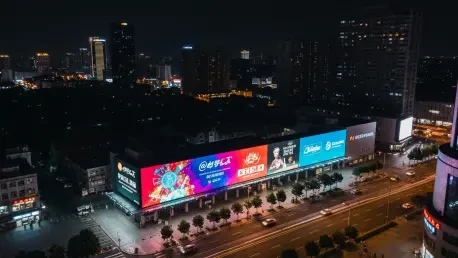

Imagine walking through a bustling city square, where a massive billboard suddenly comes to life, inviting passersby to play a game of Tetris directly from their phones, with every move mirrored on the screen for all to see. This isn’t a scene from a sci-fi movie but a real campaign by a major brand, showcasing the captivating power of experiential out-of-home (OOH) advertising. In today’s marketing landscape, where consumers crave connection over consumption, experiential OOH stands as a transformative force, blending the physical and digital worlds to create immersive brand moments. This report dives into how this medium is reshaping advertising by forging emotional bonds and delivering measurable impact, offering a window into its trends, challenges, and future potential.
Unveiling the Power of Experiential OOH Advertising
The OOH advertising industry has undergone a remarkable evolution, moving beyond static billboards to dynamic, interactive platforms that engage audiences in real time. Experiential campaigns, in particular, have surged to the forefront, capturing attention through creative, participatory experiences that resonate deeply. This shift reflects a broader trend toward immersive storytelling, where brands aim to leave lasting impressions rather than fleeting glances. Major players like Talon and Grand Visual are leading the charge, harnessing cutting-edge tools to redefine public spaces as arenas for connection.
At the heart of this transformation is the concept of ‘phygital’—a seamless merger of physical environments and digital interactions. Think of interactive billboards that respond to gestures, augmented reality (AR) overlays that transform a mundane wall into a storytelling canvas, or gamified setups that turn waiting at a bus stop into a playful brand encounter. These innovations are not just gimmicks; they align perfectly with consumer demand for experiences that feel personal and memorable, positioning experiential OOH as a vital component of modern marketing strategies.
Moreover, technological advancements such as AI-driven personalization and gesture control are amplifying the reach and relevance of these campaigns. By tailoring content to demographics or even moods, brands can create hyper-contextual interactions that stand out in crowded urban landscapes. As this medium continues to grow, its ability to bridge offline and online touchpoints makes it indispensable, offering marketers a powerful tool to build trust and engagement in an increasingly fragmented media environment.
Trends and Insights Shaping Experiential OOH
Cutting-Edge Innovations and Consumer Shifts
The experiential OOH sector is being reshaped by groundbreaking technologies that push the boundaries of creativity. Innovations like AR, projection mapping, and real-time data analytics allow campaigns to adapt dynamically, transforming static locations into responsive storytelling hubs. For instance, a billboard might display different content based on the time of day or local weather, ensuring relevance to the audience passing by. This adaptability reflects a deeper understanding of how technology can enhance, rather than overpower, the human element of advertising.
Consumer behavior, too, is driving this evolution, with a clear preference emerging for experiences over material goods. Audiences today seek interactive, shareable moments—think of a campaign that turns a public space into a stage for a livestreamed concert, inviting community participation. This shift toward emotional resonance over mere visibility is fueling demand for campaigns that feel authentic and culturally significant, creating opportunities for brands to stand out through meaningful engagement.
Additionally, market drivers such as the push for emotionally impactful initiatives and the rise of immersive gaming are opening new frontiers. Hybrid creative spaces, where physical installations blend with digital extensions, are becoming hotbeds for innovation. These trends underscore a pivotal reality: experiential OOH is no longer a niche tactic but a mainstream approach that taps into the human desire for connection and interaction in public settings.
Data-Driven Growth and Future Forecasts
The growth of experiential OOH is backed by compelling data, with engagement metrics soaring as tools like mobile ID matching and foot-traffic tracking become standard. These technologies provide granular insights into how audiences interact with campaigns, allowing brands to measure return on investment with unprecedented precision. Recent industry reports highlight that campaigns leveraging such data see significantly higher recall rates, proving that emotional impact and measurability can go hand in hand.
Looking ahead, projections suggest continued expansion as data analytics and sentiment tracking become even more integrated. Over the next few years, from now until 2027, adoption of these tools is expected to rise sharply, enabling brands to fine-tune campaigns in real time for maximum effect. This data-driven focus not only validates the medium’s effectiveness but also attracts greater investment, solidifying its role in comprehensive marketing mixes.
Beyond numbers, the future promises a wave of innovation as technologies like AI and AR mature, offering even more personalized and immersive experiences. Forecasts indicate that consumer trends favoring community-focused and interactive content will further elevate experiential OOH, positioning it as a cornerstone of how brands communicate in dynamic, public environments. The trajectory is clear: this medium is set to redefine engagement on a global scale.
Navigating Challenges in Experiential OOH Campaigns
Despite its promise, experiential OOH faces significant hurdles that brands must address to fully harness its potential. High implementation costs often pose a barrier, as creating interactive installations or integrating advanced tech requires substantial budgets. Additionally, the complexity of ensuring seamless digital-physical integration can strain resources, with technical glitches risking campaign effectiveness in high-traffic public spaces.
Market-driven challenges add another layer of difficulty, particularly audience saturation in urban centers where countless messages vie for attention. Standing out amidst this clutter demands not just creativity but also strategic precision, as brands grapple with the pressure to deliver truly unique experiences. Without differentiation, even the most innovative campaigns can fade into the background, underscoring the need for thoughtful execution.
However, solutions are within reach through strategic partnerships and scalable technology. Collaborating with tech providers can reduce costs and complexity, while a laser focus on data allows for optimized targeting and impact. By prioritizing efficiency and relevance, brands can navigate these obstacles, turning challenges into opportunities to refine and elevate their experiential OOH efforts.
Regulatory Landscape and Compliance in OOH Advertising
The regulatory framework surrounding OOH advertising is a critical consideration, especially as experiential campaigns increasingly rely on data collection via tools like QR codes and near-field communication (NFC). Privacy concerns are paramount, with strict guidelines governing how personal information is gathered and used in public spaces. Brands must tread carefully to avoid backlash, ensuring transparency in their practices.
Furthermore, restrictions on public space usage and digital content standards can impact campaign design and deployment. Potential changes in legislation, particularly around data security and urban planning, may introduce new compliance burdens. Staying ahead of these shifts is essential, as non-compliance risks not only fines but also damage to consumer trust, a currency harder to rebuild than to lose.
Ethical practices remain a cornerstone of sustainable OOH strategies, with brands urged to prioritize security in data-driven campaigns. By aligning with regulatory expectations and fostering transparency, companies can maintain audience confidence while pushing the boundaries of creativity. This balance between innovation and responsibility is key to long-term success in the evolving landscape of experiential advertising.
The Future Horizon of Experiential OOH
Envisioning the path ahead, experiential OOH appears poised for remarkable growth with emerging technologies paving the way. Concepts like geolocated AR quests, where users unlock brand experiences based on location, and playable billboards that turn idle moments into interactive games, signal a future where public spaces become live media networks. These advancements promise to deepen engagement by blending entertainment with branding in unexpected ways.
Market disruptors, including shifting consumer preferences toward personalized and community-centric campaigns, will likely redefine priorities. Economic factors on a global scale may also influence investment, yet the adaptability of experiential OOH positions it to thrive amidst change. As audiences increasingly value tailored interactions, brands that embrace customization will gain a competitive edge in this vibrant arena.
Innovation, coupled with a commitment to sustainability and regulatory alignment, will drive future growth areas. The integration of eco-friendly materials and energy-efficient technologies in installations could address environmental concerns, while creative hubs like hybrid playgrounds and live e-sport activations offer untapped potential. This forward momentum suggests that experiential OOH will continue to captivate and connect in ways yet to be fully imagined.
Reflecting on Experiential OOH’s Transformative Potential
Looking back on this exploration, it was evident that experiential OOH had carved a unique niche in advertising by forging profound emotional connections and delivering tangible brand impact. The journey through its trends, challenges, and future possibilities revealed a medium that thrived on creativity and technology in equal measure. Each campaign, whether a gamified billboard or a culturally resonant installation, had demonstrated the power to turn passive moments into active, memorable engagements.
For brands moving forward, the next steps were clear: prioritize creativity by designing campaigns that invite participation and spark conversation. Integrating robust data analytics to measure and refine impact had proven essential, as had a commitment to audience-centric storytelling. Investing in hybrid spaces and innovative activations offered a pathway to sustain momentum, ensuring that experiential OOH remained a dynamic force in marketing.
Beyond immediate actions, the industry was encouraged to explore partnerships that reduced costs and amplified reach, while staying attuned to regulatory shifts and sustainability goals. By embracing these considerations, brands could have positioned themselves not just as advertisers but as creators of shared, meaningful experiences. The legacy of experiential OOH, as reflected upon, was one of transformation—a bridge between people and brands that promised to grow stronger with every innovative step.