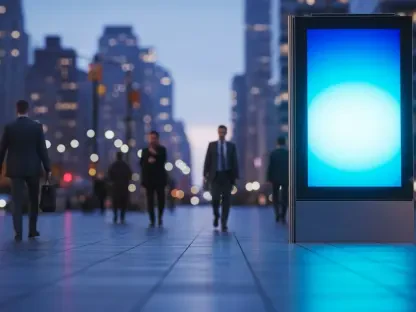

The constant scroll of a social media feed and the vibrant flash of a city billboard are no longer separate worlds for advertisers but two halves of a powerful, unified brand story. This article analyzes the strategic integration of social media and Digital Out-of-Home (DOOH) advertising to combat digital fatigue and online saturation. The central theme is that creating a continuous brand experience between personal screens and public spaces is the future of effective advertising.
The New Imperative: Bridging the Digital and Physical Worlds
As audiences navigate an increasingly saturated online environment, the challenge for brands is to create messages that not only capture attention but also retain it. The strategic integration of social media with DOOH advertising offers a compelling solution, transforming fleeting digital impressions into memorable real-world encounters. This approach addresses the growing issue of digital fatigue by extending a campaign’s narrative beyond the confines of a personal device, creating a more holistic and immersive brand presence.
The core principle behind this strategy is continuity. When a consumer sees an engaging, creator-led video on a social platform and later encounters a complementary message on a large digital screen during their commute, the brand’s story becomes more tangible and credible. This seamless transition from the digital to the physical realm reinforces the initial message, strengthening its impact and fostering a deeper connection with the audience. The goal is no longer to interrupt the consumer but to become a natural part of their daily journey, both online and off.
The Evolving Advertising Landscape
The modern advertising context has been fundamentally reshaped by the dominance of social media. Platforms have conditioned audiences to expect content that is authentic, engaging, and native to the environment in which it appears. Short-form, creator-led videos have become the benchmark for capturing genuine interest, holding a viewer’s active attention for significantly longer than traditional online display ads. This shift has raised consumer expectations, making interruptive or generic advertising far less effective.
However, this very dominance has created a new hurdle: digital fatigue. With consumers spending vast amounts of time on social platforms, the digital space is becoming overcrowded, and the impact of purely online campaigns may be reaching a plateau. This emerging challenge necessitates that brands diversify their strategies and look for ways to maintain relevance beyond the screen. Expanding into physical spaces through DOOH provides a powerful method to break through the digital noise and engage consumers in a different, often less distracting, mindset.
Research Methodology, Findings, and Implications
Methodology
The analysis is based on a synthesis of industry data, audience engagement metrics, and performance analytics drawn from both social media and DOOH platforms. This approach examines key performance indicators such as active viewing time, unaided brand recall, and purchase intent to measure the cumulative impact of an integrated campaign. By comparing the results of siloed strategies with those of combined efforts, the methodology provides a clear picture of the synergistic value created.
A central case study informing this research is the “Out of Phone” initiative, a collaboration between TikTok and the programmatic DOOH platform Displayce. This initiative provides a practical model for extending engaging, short-form video content from the social feed to premium digital billboards in high-traffic public spaces. The performance of these campaigns was meticulously tracked to quantify how a message’s effectiveness changes when it bridges the digital and physical worlds, providing a concrete example of the strategy in action.
Findings
The research reveals a powerful synergistic effect when social media and DOOH advertising are combined, increasing overall campaign effectiveness by up to 20%. While social media excels at capturing initial, highly engaged attention, DOOH serves as an unskippable and high-impact reinforcement. The public, shared nature of DOOH ads provides a context where messages are absorbed with a different quality of attention, leading to a significant boost in memory encoding.
This combination of channels yields impressive results in key metrics. Consumers exposed to a campaign across both social and OOH channels demonstrate more than double the brand recall compared to those who see it on a single platform. Furthermore, this integrated exposure makes them 1.6 times more likely to make a purchase. The data indicates strong audience receptivity to this crossover, with a majority of internet users expressing a desire to see OOH advertising that reflects the dynamic, creator-led style of popular social videos, effectively turning public spaces into an extension of the social feed.
Implications
For brands, the primary implication is the need to design for continuity across channels. This moves beyond simply repurposing a mobile video for a large screen and requires a strategic approach to creative adaptation. Content must be tailored to the unique context and format of each environment, ensuring the brand’s narrative remains consistent while optimizing for how it will be viewed—whether on a vertical phone screen or a horizontal digital billboard.
To implement this strategy at scale, leveraging programmatic DOOH technology is essential. Programmatic platforms provide the tools to efficiently secure premium, high-visibility placements that align with a campaign’s target audience and creative goals. This allows brands to curate a network of digital screens in landmark locations, ensuring that the transition from the social feed to the physical world is both seamless and impactful, thereby maximizing the return on their advertising investment.
Reflection and Future Directions
Reflection
The most significant challenge in executing an integrated social and DOOH strategy lies in its operational complexity. It requires aligning creative development, media planning, and campaign execution across two historically separate ecosystems, each with its own standards, workflows, and measurement systems. Overcoming this hurdle demands a fundamental shift in mindset, moving away from channel-specific planning toward a holistic view of the customer journey.
This shift requires cross-functional collaboration and a shared understanding that brand impact is not built in a single moment but through a series of consistent, reinforcing touchpoints. Advertisers must think less about the individual performance of a social post or a billboard and more about how they work together to guide a consumer from initial awareness to final action. Success depends on breaking down internal silos and adopting a unified strategy centered on the audience’s experience.
Future Directions
Future research should aim to quantify the long-term effects of this integrated approach on brand equity and customer loyalty. While short-term metrics like recall and purchase intent are strong, understanding how a continuous presence across digital and physical spaces builds lasting brand affinity is the next frontier. This could involve longitudinal studies that track consumer sentiment and behavior over extended periods.
There are also significant opportunities to explore best practices for creative adaptation. Research could identify which types of social content translate most effectively to various DOOH formats, from large-format billboards to smaller, place-based screens in retail environments. Additionally, measuring the impact of emerging interactive technologies, such as QR codes or augmented reality features that link physical ads directly back to social platforms, will provide valuable insights into closing the loop between the two worlds.
A Unified Strategy for Lasting Brand Impact
The integration of social media and DOOH advertising represented more than an additive tactic; it acted as a multiplier for brand impact. By leveraging social platforms to capture engaged attention and using DOOH to anchor that message in the real world, brands built a powerful foundation of credibility and recognition. This approach enhanced memory encoding, ensuring that fleeting digital engagement translated into a more durable mental impression.
This unified strategy proved essential for cutting through the noise of a fragmented media environment. The consistent presence across personal and public screens signaled brand confidence and intent, fostering trust with consumers. Ultimately, this seamless journey from the social feed to the city street guided consumers more effectively toward action, demonstrating that the most impactful brand stories are those that are lived, not just seen.