
In the rapidly shifting landscape of digital media, few experts navigate the intersection of data and content as skillfully as Anastasia Braitsik. With a career defined by her mastery of SEO, content marketing, and complex data analytics, she has become a pivotal voice for brands looking to bridge the gap between creative storytelling and hard numbers. As a global leader in the field, she brings a unique perspective on how technical standards influence the way we consume and monetize digital narratives. Our conversation today centers on the recent transformation of the podcasting industry, exploring the technical nuances of the IAB Tech Lab’s latest updates and what they signify for the future of multi-sensory marketing. We delve into the critical shift from “listeners” to “consumers,” the technical hurdles of server-side measurement, and the roadmap toward a more transparent, video-integrated ecosystem.
The industry is making a significant pivot by moving away from the term “listener” in favor of “podcast consumer” to encompass the rise of video formats. From your perspective as a data and content expert, how does this linguistic shift change the way marketers should approach their storytelling and measurement strategies?
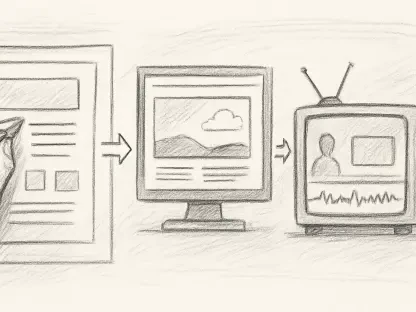
This shift is far more than just a semantic update; it represents a fundamental acknowledgement that our senses are being engaged in entirely new ways. When we transition to the term “podcast consumer,” we are essentially moving away from a single-channel mindset and embracing a world where a show might be experienced as a background melody or a focused visual spectacle. In Version 2.3 of the Podcast Technical Measurement Guidelines, this change acknowledges that the modern audience isn’t just plugged in via earbuds; they are leaning into screens, watching the subtle facial expressions of hosts on YouTube or specialized apps. For a marketer, this means storytelling can no longer be “audio-first” in a vacuum. You have to consider the visual aesthetics of the studio, the on-screen graphics, and how those elements synchronize with the server-side file delivery. It forces us to measure the “eyes on glass” as much as the “ears on the ground,” creating a much richer, albeit more complex, data set that reflects a truly holistic engagement with the brand.
Standardized measurement has often been a point of friction in digital advertising, leading to what many call “unnecessary questions” during deal-making. How do the new IAB Tech Lab guidelines specifically address these inconsistencies to create a more frictionless environment for publishers and advertisers?
One of the most persistent headaches in this industry has been the lack of a “universal language” for success, but these updates provide the crisp clarity that publishers have been begging for. As Anthony Katsur pointed out, the ecosystem only functions effectively when everyone is counting the same way, and Version 2.3 is a massive step toward that unified front. By updating the framework for measuring downloads and ad delivery using server-side log data, the guidelines act as a stabilizer for a market that has felt a bit like the Wild West. When a hosting provider and an advertiser look at a report, they need to know that the measurement window and the identification of invalid traffic are based on the same rigorous logic. This reduces the friction during negotiations because the numbers are no longer up for interpretation; they are validated by a shared technical agreement. This consistency is the “secret sauce” that allows deals to move from the boardroom to execution without getting bogged down in disputes over metric discrepancies.
Since many podcast apps still lack client-side playback confirmation, the industry remains heavily reliant on server-side measurement. Could you walk us through the technical importance of measuring URL prefixes and handling RSS enclosure changes as outlined in this new draft?
The reliance on server-side logs is a necessity born from the fragmented nature of the app landscape, and it requires a very high level of technical hygiene to get right. Measuring URL prefixes is essentially about tracking the journey of a file before it even reaches the consumer’s device, ensuring that every redirect and every ping is accounted for in a standardized way. When we talk about RSS enclosure URLs, we’re dealing with the very plumbing of the podcast world; any change there can lead to “ghost” downloads or missed metrics if not handled with the precision outlined in these guidelines. The draft provides a roadmap for publishers to manage these shifts without losing the integrity of their data, which is vital when you’re trying to prove ROI to a skeptical client. It’s about creating a transparent trail of digital breadcrumbs that allows us to see the delivery of a file even when the “play” button on the user’s end remains a black box. This level of granular detail is what separates a professional, scaleable campaign from a shot-in-the-dark experiment.
With video podcasts gaining massive traction, marketers are looking for assurance that their metrics remain comparable across different formats. How does this draft provide that confidence, and what are the implications for those who are still hesitant to invest in the video side of the medium?
Marketers are naturally risk-averse when it comes to unproven formats, but the explicit inclusion of video podcasts in this draft should act as a green light for the hesitant. The guidelines now address video delivered through open RSS feeds and apps relying on server-side delivery, ensuring that a “view” and a “listen” can finally live in the same analytical neighborhood. This means a brand can look at a campaign and understand that the consumer who watched the video version of a show is being measured with the same rigor as the one who only heard the audio. This comparability is the bridge that allows for larger, cross-platform budget allocations. We are moving toward a reality where the “medium” is the show itself, and the “format” is just a user preference. For those still on the fence, the message is clear: the technical infrastructure is finally catching up to the consumer’s behavior, and the data will be there to support your investment when the final version is published after the August 19 comment period.
The IAB Tech Lab is already looking toward Version 3.0, even as the public comment period for 2.3 is ongoing. What is your forecast for the next stage of podcast measurement, and how should brands prepare for the “Version 3.0” era?
My forecast is that we are heading toward an era of hyper-personalization where the boundaries between “content” and “ad” become almost invisible to the consumer’s eye and ear. Version 3.0 will likely lean even harder into the visual and interactive components, perhaps even finding ways to bridge the gap between server-side delivery and more advanced client-side confirmations as technology matures. Brands should prepare by auditing their current RSS strategies and ensuring their content is “video-ready” today, not a year from now. We are going to see a surge in AI-driven execution where the measurement isn’t just about whether a file was downloaded, but how the consumer’s journey evolved across multiple touchpoints. The smart money is on publishers who are already experimenting with these hybrid formats and are ready to embrace the even more granular standards that 3.0 will inevitably bring. If you aren’t thinking about your “podcast consumer” as a multi-dimensional user who demands high-quality production in both audio and video, you will likely find yourself left behind in a very noisy marketplace.