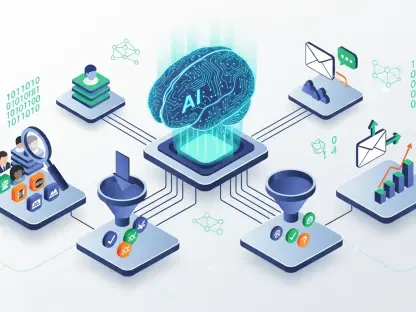

A quiet but profound revolution is fundamentally reshaping the email inbox, transforming a communication channel once dominated by human interaction into a sophisticated, automated ecosystem. For decades, marketers have honed the art of crafting messages for human eyes, focusing on compelling subject lines and persuasive calls to action. However, the role of artificial intelligence has evolved far beyond its original function as a simple spam filter. AI now acts as an intelligent gatekeeper, summarizing content, prioritizing messages, and often taking action long before a person ever sees the email. This shift marks the transition from a human-to-human communication model to an agent-to-agent (A2A) system, where marketing emails are increasingly evaluated first by machines. As major providers like Gmail and Yahoo Mail integrate AI-generated summaries, the traditional elements of email marketing are rapidly losing their relevance, forcing a complete reconsideration of how campaigns are created, measured, and managed in this new reality.
1. The Dawn of the Agent to Agent Ecosystem
The familiar landscape of email marketing is yielding to an agent-to-agent communication paradigm where success is dictated by machine interpretation rather than human emotion. In this evolving environment, a sender’s AI agent crafts messages designed to achieve specific business objectives, leveraging customer data for personalization. Upon arrival, the recipient’s AI agent intercepts the message, making a critical decision: whether to present it to the human user, generate an automated response, or archive it without any human interaction at all. This means that painstakingly crafted subject lines and preheaders, once the key to capturing attention, may be rewritten, reordered, or ignored entirely by the AI. As Christopher Penn, co-founder of TrustInsights.ai, notes, “Most everything’s going to be agent to agent. The menial part of reading the email and seeing if it’s relevant is done.” The implication is clear: email is becoming less of a narrative medium and more of a structured data transport system designed to trigger specific outcomes in other automated systems.
This new reality raises a critical question: who controls the AI agents, and what instructions are they programmed to follow? The effectiveness of an email campaign now hinges less on creative copy and more on how the recipient’s agent is configured. An agent could be instructed with a simple focus, such as prioritizing messages from known contacts, or it could employ more sophisticated rules, automatically moving emails from unknown senders to “varying levels of oblivion.” Marketers must also contend with the increasing intelligence of these systems. Modern AI includes “guard models” designed to detect and neutralize prompt injection attacks—attempts to manipulate the AI’s output, such as by instructing it to always recommend a specific product or individual. These defenses ensure that the AI adheres to its primary user’s intentions, making it even more crucial for marketers to provide genuine, relevant value that aligns with the recipient’s configured preferences rather than trying to game the system with clever tricks.
2. Redefining Success in an Automated Inbox
With AI agents acting as the primary evaluators of email, traditional performance metrics like open rates and click-through rates (CTR) are becoming increasingly misleading and irrelevant. An email might be “opened” by a machine for processing without ever being seen by a human, rendering the open rate an unreliable indicator of actual engagement. Similarly, a click might be simulated by the agent to fetch information without the user ever visiting the landing page. In this context, the definition of success must shift from capturing attention to driving tangible, measurable results. The focus is no longer on enticing a human to open a message but on providing structured, machine-readable information that prompts a desired action. Success is now quantified by completed tasks, such as a meeting being automatically scheduled, a return being processed, or a subscription being updated—outcomes that provide clear business value and signify that the email has successfully navigated the AI-driven ecosystem.
This evolution necessitates a much deeper and more dynamic approach to personalization, rendering previous methods obsolete. Simply inserting a customer’s name in the subject line or referencing a past purchase is no longer sufficient to pass the scrutiny of advanced inbox intelligence. These systems prioritize profound relevance, analyzing a wide array of signals including recent user searches, on-site product interactions, support ticket history, and previous engagement patterns. If a marketing email does not align with these real-time behavioral indicators, it is likely to be filtered out before it ever has a chance to reach the recipient. Consequently, brands must move beyond broad segmentation and embrace real-time, behavior-based targeting. Triggered emails initiated by specific customer actions—such as browsing a product category, abandoning a shopping cart, or contacting customer support—are becoming far more critical than generic, mass-sent campaigns, as they demonstrate an immediate and undeniable relevance that AI agents are programmed to recognize and reward.
3. Navigating the New Landscape of Owned Channels
The growing influence of AI extends beyond the inbox, fundamentally altering how consumers find and interact with information online. The rise of conversational AI like ChatGPT and Gemini, coupled with Google’s integration of AI Overviews in search results, is leading to a significant increase in “zero-click” searches. Users now receive direct answers to their queries on the search results page itself, reducing the need to click through to company websites. This trend is causing a noticeable decline in organic web traffic, diminishing the effectiveness of traditional search engine optimization strategies. In this challenging environment, the value of owned marketing channels has soared. Channels like email, SMS lists, and dedicated community spaces are becoming indispensable assets because they provide a direct, unfiltered line of communication between a brand and its audience. Unlike social media or search, where visibility is dictated by opaque and constantly changing algorithms, email allows brands to engage with their customers on their own terms.
Recognizing this strategic shift, savvy marketers are doubling down on their investment in owned channels, particularly email. The “2026 Marketing Predictions Report” from Iridio Research found that 44% of marketers plan to increase their email budget, signaling a clear understanding of its growing importance. Furthermore, the Content Marketing Institute’s recent B2B trends report revealed that 85% of B2B marketers are already using personalization in their email campaigns, while 54% identify email newsletters as one of their top three most effective channels for establishing thought leadership. These figures underscore a broader industry trend: as external platforms become more saturated and algorithmically controlled, the ability to nurture a direct relationship with an audience becomes a powerful competitive advantage. Building and maintaining a robust email list is no longer just a best practice; it is a critical strategy for ensuring brand resilience and sustained growth in an AI-dominated digital landscape.
4. Implementing Practical Steps for AI Readiness
To thrive in this new era, marketers must proactively adapt their strategies and infrastructure. The first crucial step is to conduct a thorough audit of the current email technology stack and associated workflows. It is essential to determine whether existing tools are equipped to handle AI-triggered campaigns and if they can seamlessly integrate with real-time customer data sources. Without this capability, delivering the deep relevance that AI agents demand is impossible. Simultaneously, success metrics must be fundamentally updated. The focus must shift away from vanity metrics like opens and clicks toward tracking concrete engagement outcomes, such as qualified conversions, direct replies, meetings booked, and tangible influence on the sales pipeline. Finally, content itself needs to be prepared for AI consumption. This involves adding structured data, using consistent language, and clearly defining the intent of each message so that a machine can easily parse the content and identify the desired action, ensuring the email is correctly interpreted and prioritized by the recipient’s AI agent.
Beyond technology and metrics, preparing for an AI-driven future requires a significant investment in people and processes. Organizations should begin building AI-specific roles into their marketing teams, such as a “prompt strategist” responsible for crafting effective inputs for AI content generation, a “brand quality reviewer” to ensure consistency, and an “AI content approver” who holds ultimate accountability for tone and accuracy. This human-in-the-loop system is vital for maintaining trust, as research shows a significant gap between how companies perceive their AI interactions and how customers actually feel about them. Campaign brief templates also need to be revisited; weak, ambiguous inputs inevitably lead to weak AI outputs. Standardizing requests to include target outcomes, brand voice guidelines, and prompt suggestions will drastically improve quality. Lastly, teams must be trained in a new skill set: how to effectively review AI-generated content, detect subtle inaccuracies or “hallucinations,” and rewrite drafts that miss the mark. This commitment to human oversight will be the ultimate guardrail for a brand’s credibility.
5. A Retrospective on the AI Transformation
The evolution of email marketing was not a sudden upheaval but a steady, inevitable progression driven by advancements in artificial intelligence. Marketers who successfully navigated this transition were those who recognized early that the fundamental nature of the channel had changed. They understood that email was no longer just a digital letter but had become a sophisticated data packet designed for machine interpretation. These forward-thinking teams shifted their focus from crafting emotionally resonant narratives for humans to engineering structurally sound, outcome-oriented messages for AI agents. They embraced the challenge by auditing their technology, redefining their metrics, and fundamentally altering how they approached content creation.
Ultimately, the brands that thrived were those that balanced automation with authenticity. They invested in new roles and rigorous training, creating human-in-the-loop systems that preserved their brand’s voice and protected customer trust. They saw that while the initial reader of an email had become a machine, the ultimate goal remained the same: to deliver tangible value to a human recipient. By designing their communications for this new, dual audience, they not only ensured their messages were seen and acted upon but also solidified their position as leaders in a complex and automated landscape. Their success was a testament to the idea that true innovation lay not in replacing human oversight but in augmenting it with intelligent technology.