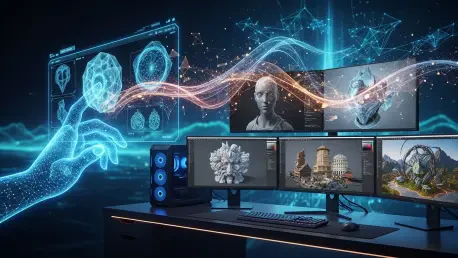

The era of painstaking manual vertex manipulation and labor-intensive UV mapping is quickly receding as artificial intelligence transforms the fundamental nature of 3D asset production. Where a single high-fidelity character or architectural visualization once required dozens of specialists and weeks of dedicated modeling time, the current landscape allows for near-instantaneous generation of complex geometries and hyper-realistic textures. This shift is not merely an incremental improvement in software tools but a complete paradigm shift that democratizes high-end visual production across various sectors. As the demand for immersive experiences in augmented reality, virtual training, and digital retail surges, traditional manual pipelines are struggling to keep pace with the sheer volume of assets required. The integration of generative models into standard professional workflows has turned what was once a technical bottleneck into a scalable utility, enabling smaller studios to compete with global powerhouses. This evolution marks a turning point where the creative focus shifts from the mechanics of construction to the nuances of artistic direction and conceptual innovation.
Catalysts for the Rapid Shift to Automation
The democratization of high-fidelity modeling is primarily driven by the exponential improvement in the accuracy of large-scale generative models. Until recently, the barrier to entry for professional 3D production was defined by the steep cost of high-end workstations and the thousands of dollars required for specialized software licensing and expert labor. Today, however, these generative tools can interpret complex natural language prompts or analyze simple reference photos to output mesh structures that require only minimal refinement. This accessibility has empowered small creative agencies and solo developers to undertake ambitious projects, such as full-scale environmental design or intricate character modeling, which were previously the exclusive domain of major entertainment studios. By lowering the financial and technical thresholds, AI has fostered a more competitive market where the quality of the underlying idea often outweighs the size of the production budget. The ability to iterate rapidly on multiple design variations in real-time has allowed teams to explore a wider range of creative possibilities without the fear of wasting hundreds of man-hours on discarded concepts.
Beyond the internal efficiency of creative teams, the surge in consumer expectations for interactive digital experiences has necessitated a move toward automation. The explosion of virtual reality and the maturation of spatial computing have created a massive appetite for 3D assets that traditional hand-crafted methods simply cannot satisfy at scale. Industry leaders have responded by embedding AI engines directly into professional-grade design suites, ensuring that these capabilities are not merely peripheral experiments but core components of the modern toolkit. This integration ensures that the resulting assets are compatible with existing rendering engines and animation rigs, bridging the gap between experimental AI outputs and production-ready content. Furthermore, the push for environmental sustainability in the tech sector has encouraged the use of virtual prototypes over physical models, further accelerating the reliance on automated 3D pipelines. As companies look toward the period from 2026 to 2028, the focus is increasingly on building sustainable, AI-driven content ecosystems that can automatically update and adapt to new hardware platforms without human intervention.
Underlying Technologies Powering the Transition
At the heart of this technical revolution are three core methodologies: Diffusion models, Generative Adversarial Networks (GANs), and Neural Radiance Fields (NeRFs). Diffusion models have proven exceptionally effective at conceptualizing the structural foundation of a 3D object, often starting from a cloud of random noise and gradually refining it into a recognizable shape based on training data. This process allows for a level of creativity and variation that was previously impossible to automate, as the AI can synthesize entirely new forms rather than just duplicating existing templates. While Diffusion handles the primary geometry, GANs are frequently employed to manage the surface level details, using a competitive learning process to generate textures that are indistinguishable from real-world materials. This dual-layered approach ensures that the final model possesses both the structural integrity required for physics simulations and the visual fidelity needed for high-end rendering. By offloading these foundational tasks to specialized algorithms, developers can ensure a consistent level of quality across thousands of unique assets in a fraction of the time.
A particularly transformative development is the rise of Neural Radiance Fields, which have fundamentally altered how virtual environments are captured and reconstructed. NeRF technology allows creators to take a series of standard 2D photographs and synthesize a photorealistic 3D scene that can be viewed from any angle with accurate lighting and reflections. This capability is vital for the creation of digital twins—highly accurate virtual replicas of real-world buildings, cities, or industrial equipment. Unlike traditional photogrammetry, which often struggles with shiny or transparent surfaces, NeRFs use sophisticated neural networks to predict how light interacts with every point in space, resulting in a much more immersive and realistic representation. This technology has streamlined the process of digitizing the physical world, making it possible for an architect to scan a construction site with a smartphone and generate a usable 3D model within minutes. These advancements collectively provide a comprehensive toolkit that covers the entire lifecycle of a digital asset, from its initial conceptualization to its final deployment in a complex virtual ecosystem.
Redefining the Role of the Digital Artist
The integration of artificial intelligence has prompted a significant evolution in the day-to-day responsibilities of professional 3D artists. In the traditional workflow, a significant portion of an artist’s time was consumed by repetitive tasks such as retopology, which involves simplifying the geometric structure of a model for better performance, or UV unwrapping to prepare a surface for textures. With AI now handling these mechanical burdens, the artist’s role has shifted toward that of a creative director or curator. Instead of building every polygon from scratch, professionals now focus on setting the parameters for generative tools and then meticulously refining the output to ensure it aligns with the specific artistic vision and technical requirements of a project. This shift allows for a much higher level of creative experimentation, as artists can generate and evaluate dozens of different designs in the time it used to take to finish a single model. The emphasis is no longer on the technical ability to navigate complex software menus but on the aesthetic judgment required to choose and polish the best possible version of a concept.
This new dynamic has also opened the door for designers and hobbyists who may lack the years of specialized training traditionally required to master 3D software. Text-to-3D and image-to-3D tools provide a bridge for those with strong conceptual ideas but limited technical proficiency, allowing them to participate in the creative process more directly. In a professional studio setting, this democratization facilitates better collaboration between different departments, as a concept artist or a game writer can quickly generate a rough 3D prototype to illustrate a point during a meeting. This immediate visualization reduces the risk of miscommunication and ensures that everyone on a project is working from the same visual foundation. While some feared that automation would displace human talent, the reality has been an expansion of the creative workforce, as the demand for high-quality oversight and artistic nuance has never been higher. The future of digital craftsmanship is increasingly defined by the synergy between human intuition and machine speed, creating a more inclusive and efficient production environment for all stakeholders.
Cross-Industry Impact and Real-World Implementation
The retail and e-commerce sectors have been among the earliest and most enthusiastic adopters of AI-driven 3D creation. Modern consumers increasingly expect to interact with products in three dimensions, using augmented reality to place furniture in their living rooms or to see how a pair of glasses fits their face before committing to a purchase. Creating these high-fidelity models for every item in a catalog was once prohibitively expensive for most retailers, but AI has drastically lowered the cost per asset. This allows companies to digitize their entire inventory, providing a more engaging shopping experience that has been shown to increase conversion rates and significantly reduce the frequency of product returns. Furthermore, these 3D assets can be used across multiple marketing channels, from social media advertisements to interactive web displays, ensuring a consistent brand image without the need for multiple expensive photo shoots. As retail continues to move toward a more digital-first model, the ability to generate and manage a massive library of 3D content has become a critical competitive advantage.
In fields like architecture and urban planning, the application of automated 3D modeling has revolutionized how projects are visualized and tested. Architects now use AI tools to generate highly detailed simulations of how sunlight, wind, and traffic flow will affect a proposed building design, allowing for more informed decision-making during the early stages of development. Similarly, in the healthcare industry, the technology is used to convert 2D medical imaging data, such as CT or MRI scans, into accurate 3D models of a patient’s anatomy. These models are invaluable for surgical planning, allowing doctors to practice complex procedures in a risk-free virtual environment before entering the operating room. Even the gaming industry has seen a massive shift, with developers using AI to procedurally generate vast, detailed landscapes and background assets, freeing up human artists to focus on the most important story-driven elements of the game. Across all these diverse fields, the common thread is the use of AI to transform raw data into actionable, high-quality visual information that enhances productivity and improves outcomes.
Future Horizons and Navigating Current Challenges
While the benefits of automated 3D production are substantial, the industry must navigate several significant hurdles to ensure continued growth. One of the primary concerns is the quality and ethics of the data used to train these powerful generative models, as biased or low-quality training sets can lead to errors in the final output or legal disputes over intellectual property. Many organizations have found it difficult to integrate these new AI tools into their legacy workflows, which were often built around rigid, manual processes that are not easily adapted to the speed of generative technology. There is also a pressing need for clearer legal frameworks regarding the ownership of AI-generated assets, as current laws are often ill-equipped to handle the nuances of machine-assisted creation. As these technical and regulatory challenges are addressed, the focus will likely shift toward creating more seamless, interoperable systems that allow for the effortless transfer of assets between different platforms and industries, making complex digital creation a standard utility for every business.
The transition toward automated 3D production necessitated a fundamental re-evaluation of how intellectual property and data integrity were handled within the design space. Organizations that successfully integrated these technologies recognized that the human element remained indispensable for fine-tuning the nuances of lighting and physics that AI occasionally misinterpreted. This period of rapid adoption demonstrated that the most effective strategies involved a hybrid approach, where machine speed complemented human aesthetic judgment. Legal frameworks began to evolve to address the complexities of AI-generated assets, providing clearer pathways for commercialization and ownership. Ultimately, the industries that flourished were those that prioritized the continuous training of their workforce to master these new tools while maintaining high standards for technical precision. These developments established a new baseline for digital craftsmanship, ensuring that the creation of immersive worlds became a more intuitive and inclusive process for creators across all disciplines.