
In a striking contradiction that has left many industry leaders questioning their strategies, the advertising landscape of the past year witnessed marketers systematically pulling back on social media investments precisely as the channel’s efficiency and return on investment reached new heights. This puzzling divergence signals a profound reevaluation of digital marketing, where gut feeling and perceived risk are clashing with hard performance data. As brands navigate a complex environment shaped by economic uncertainty and shifting consumer habits, the decision to reduce spend on a high-performing channel reveals deeper anxieties about platform volatility, regulatory oversight, and the ongoing search for stable, long-term growth.
The Great Rebalancing: A Snapshot of the 2025 Advertising Landscape
The advertising industry underwent a significant recalibration last year, characterized by a deliberate reshuffling of budgets across major channels. This strategic realignment was not merely a response to economic pressures but a calculated reaction to fundamental shifts in consumer media consumption. Marketers demonstrated a clear intent to optimize their spend for maximum impact, leading to a dynamic environment where established platforms saw their dominance challenged and emerging channels gained new ground. The overarching trend was a move toward channels that could offer either unparalleled performance or perceived stability in an increasingly fragmented market.
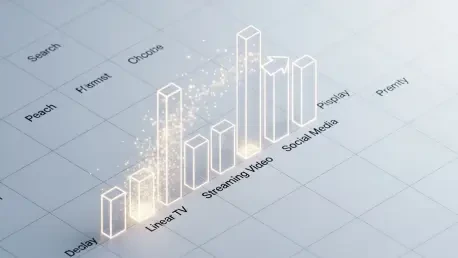
A closer look at the allocation of advertising dollars reveals a clear hierarchy of priorities. Search marketing reaffirmed its foundational role, capturing a commanding 25% of total budgets and continuing to deliver reliable returns. In contrast, Linear Television, while still holding a substantial 19% share of spend, showed clear signs of waning influence as its effectiveness steadily declined. Streaming Video and Social Media were neck and neck, each accounting for 17% of investment, though their strategic roles and performance narratives diverged significantly. Rounding out the top five, Display advertising experienced a notable surge, growing its budget share to 15% as brands increasingly turned to it for consistent and predictable performance.
Decoding the Data: Unpacking Channel Performance and Strategic Shifts
The ROI Paradox: Why Rising Social Media Returns Didnt Stop Budget Cuts
Social media presented the most compelling paradox of the year. Despite a demonstrable surge in its return on investment, the channel’s overall share of advertising budgets slipped from 18% to 17%. This counterintuitive trend suggests that marketers’ decisions were influenced by factors beyond simple ROI calculations. Challenges such as platform fragmentation, brand safety concerns, and the looming threat of regulatory action created a sense of instability that overshadowed the channel’s improving efficiency. Consequently, many brands opted to de-risk their portfolios by trimming social media spend, even if it meant leaving potential returns on the table.
The story within social media was one of dramatic internal shifts and platform-specific fortunes. Meta, encompassing Facebook and Instagram, staged a powerful comeback, increasing its share of social investment from 55% to 60%, bolstered by a favorable ROI and declining ad costs. Conversely, TikTok saw a significant investment pullback after a period of rapid growth, with its market share dropping by eight percentage points. Interestingly, this reduced spending coincided with a jump in TikTok’s ROI, largely driven by lower advertising costs. Meanwhile, platforms like Pinterest capitalized on the fragmentation, growing its share of social spend as brands diversified their strategies and tested alternative environments to reach engaged audiences.
Cross-Channel Scorecard: Where Every Advertising Dollar Went and What It Returned
A data-driven scorecard of channel performance provides a clear picture of last year’s investment landscape. Search marketing remained the undisputed leader in both spend and efficiency, delivering a strong average ROI of $1.70 for every dollar invested. Its position as the primary channel for capturing consumer intent makes it an indispensable component of the modern marketing mix. Its consistent performance offers a baseline of reliability that many brands leaned on during a period of broader market uncertainty.
In contrast, other channels exhibited more dynamic and evolving performance profiles. Streaming Video continued its ascent, maintaining a stable share of investment while demonstrating steady ROI growth over time, solidifying its role as the heir apparent to linear TV for brand-building initiatives. Linear TV itself struggled, with its waning effectiveness becoming a primary driver for budget reallocation toward digital alternatives. Display advertising was a key beneficiary of this shift, seeing its budget allocation grow significantly as marketers prized its reliability and consistent, if not always spectacular, returns for both brand and performance objectives.
Navigating the Headwinds: Fragmentation Perception Gaps and Strategic Challenges
Marketer uncertainty in the current landscape is fueled by a host of complex challenges, extending from the granular level of platform selection to broad strategic disconnects. The social media ecosystem, in particular, has become highly fragmented, forcing brands to make difficult choices about where to allocate limited resources for the best return. This fragmentation creates operational overhead and strategic complexity, contributing to the cautious investment approach observed despite strong performance metrics.
A significant tension has also emerged within the rapidly growing streaming video sector, highlighting a critical gap between perception and performance. Connected TV (CTV) has been attracting a larger share of investment dollars, driven by the narrative of its premium, lean-back viewing experience and its official milestone of surpassing traditional broadcast and cable viewership. However, the data reveals that Online Video, led by platforms like YouTube, delivered a superior aggregate ROI. This disconnect suggests that investment decisions in streaming are being heavily influenced by the perceived prestige of the CTV environment, even when more efficient options are available.
The Compliance Conundrum: How Regulatory Pressure Is Reshaping Digital Strategy
The digital advertising ecosystem is operating under the increasing shadow of regulatory pressure and heightened consumer awareness of data privacy. These forces are profoundly influencing strategic decisions, prompting a notable pullback from channels perceived as carrying higher compliance risks. The slight decline in overall social media investment, for instance, can be partly attributed to concerns over data handling practices, platform accountability, and the potential for future legislative action that could disrupt established targeting and measurement capabilities.
This compliance conundrum is accelerating a strategic pivot toward channels that offer greater transparency and stability. Marketers are showing a growing preference for platforms with strong first-party data assets and walled-garden environments that provide more control and perceived safety. This shift favors retail media networks and established players in search and streaming, which are often seen as more insulated from the regulatory headwinds buffeting the open web and certain social platforms. The result is a more cautious and compliance-aware approach to media planning, where risk mitigation is becoming as important as performance maximization.
Beyond the Horizon: The Future of Ad Spend and Emerging Opportunities
Beneath the surface of major channel shifts lie significant, often overlooked, growth opportunities. Audio, for example, represents a pocket of immense efficiency. Despite commanding only a small fraction of total media budgets, it delivered strengthening returns, with terrestrial radio surprisingly surging to an ROI of $4.00, the highest among audio formats. This was likely a result of declining advertiser competition, creating a buyer’s market. Furthermore, a deeper analysis into campaign timing revealed a massive untapped value source. Optimizing the flighting of investments based on decay rates can dramatically multiply profitability, turning a modest return into an exceptional one.
Looking ahead, the industry is on the cusp of a technological transformation that will redefine marketing operations. The era of tentative AI experimentation is rapidly giving way to the scaled implementation of autonomous “agentic AI” systems. Major platforms have already begun rolling out these capabilities, which use conversational interfaces to manage entire campaigns, from creation and optimization to analytics. This shift promises to automate complex manual processes, freeing up strategists to focus on higher-level planning and creative thinking, and will fundamentally alter the skills required to succeed in the marketing organizations of tomorrow.
The 2026 Playbook: A Data-Backed Roadmap for Smarter Marketing Investment
The cumulative data reinforces a clear, multi-year trend: brands are methodically shifting investment up the marketing funnel. This strategic pivot places a greater emphasis on long-term brand building alongside immediate performance marketing. The data shows a steady increase in top-of-funnel allocations, particularly from larger brands, with channels like Streaming Video and Social Media taking on greater responsibility for driving awareness. This realignment reflects a growing understanding that sustainable growth requires a healthy balance between capturing existing demand and creating it for the future.
For marketers charting a course for the year, a data-backed playbook has emerged from last year’s performance trends. The primary directive is to accelerate the transition of budgets from the diminishing returns of Linear TV to the growing reach and effectiveness of Streaming. It is also clear that reinvesting in Social Media is a smart move, provided it is done with disciplined platform selection focused on environments delivering proven efficiency. Finally, the evidence supports expanding the role of Display as a reliable full-funnel channel and committing to testing emerging high-ROI channels like Audio at a scale significant enough to generate meaningful learnings and impact.