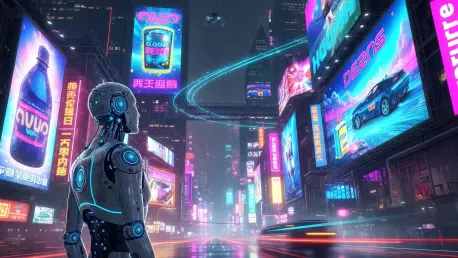

As the advertising industry stands at a technological crossroads, a pivotal question emerges for one of its oldest forms: will artificial intelligence become the ghost in the machine for Out-of-Home creative, or its most powerful muse? While generative AI tools aggressively automate creative production across social and search platforms, a compelling counter-narrative is taking shape on the streets. This report examines the unique trajectory of AI within the OOH sector, arguing that its greatest potential lies not in replacing human ingenuity but in augmenting it, promising to solve the industry’s most persistent challenges and unlock a new era of contextual, high-impact advertising.
The State of the Streets a Decade of Digital Transformation in OOH
The Out-of-Home landscape has undergone a seismic shift over the past decade, methodically rebuilding itself into a programmatic, data-driven powerhouse. The primary focus of this transformation has been the development of a vast technical infrastructure, connecting thousands of digital screens into addressable networks. Technology providers have led this charge, creating a sophisticated ecosystem capable of delivering ads with digital precision to specific audiences, at specific times, and in specific locations.
This technological leap forward, however, has created a foundational imbalance. While the industry succeeded in making its inventory programmatic and its targeting data-informed, the creative processes that feed these advanced systems have not kept pace. The capacity for dynamic ad delivery has far outstripped the ability to produce dynamic, contextually relevant creative at scale. This gap between technical capability and artistic evolution represents the central challenge and greatest opportunity facing the OOH industry today.
The Fork in the Road Contrasting AI Trajectories in Advertising
The implementation of artificial intelligence in advertising is not a monolithic trend; rather, it is diverging down two distinct paths, shaped by the unique characteristics of different media channels. In the world of online advertising, the destination is full automation. In contrast, the high-stakes, environmentally dependent nature of OOH is fostering a different model entirely—one where AI serves as an intelligent co-pilot, empowering human creativity rather than supplanting it.
The Race to Full Automation AIs Creative Takeover in Social and Search
In the dominant digital channels of social media and search, the race is on to minimize human intervention in the creative process. Tech giants are developing increasingly sophisticated generative AI tools designed to automate everything from asset creation to campaign optimization. Platforms like Meta and Google are leading this charge, introducing suites that can generate images, write copy, and edit video with minimal input, aiming for a future where an advertiser needs only to provide a product link and a budget, leaving the AI to handle the rest.
This trend toward a fully automated model is driven by the high-volume, low-stakes nature of online ads. An underperforming digital creative can be swapped out in milliseconds with negligible cost. This environment encourages rapid, AI-driven iteration and testing, where efficiency and scale are prioritized above all else. The ultimate goal is a self-optimizing system where AI manages targeting, asset generation, and delivery, effectively removing the human creative from the day-to-day operational loop.
The ROI Paradox OOHs Untapped Potential by the Numbers
In stark contrast to its digital counterparts, the financial case for OOH presents a compelling paradox. Research consistently demonstrates its superior effectiveness, delivering a marginal return on investment of $7.58 for every incremental dollar spent—significantly higher than the media average of $5.52. Despite this proven ROI, OOH commands less than 1% of total media spending. This glaring discrepancy points directly to systemic barriers that have prevented the channel from capturing a budget share commensurate with its impact.
The primary obstacle is the creative production challenge. The high cost, long lead times, and logistical complexities of producing and deploying OOH campaigns have made it difficult for brands to generate the volume of high-quality, contextually relevant creative needed to fully leverage the medium’s programmatic capabilities. This bottleneck not only limits campaign effectiveness but also makes it difficult for OOH to compete for budgets against more agile digital channels. It is this very problem that positions AI not as a creative replacement but as a strategic solution to unlock the medium’s immense financial potential.
The Creative Bottleneck When Tech Infrastructure Outpaces Artistic Innovation
The core challenge facing the modern OOH industry is the critical disconnect between its advanced ad delivery systems and its lagging creative production capabilities. The programmatic infrastructure is primed for dynamism, capable of serving different ads based on time of day, weather, or audience data. Yet, the creation of assets remains a largely manual, time-intensive, and expensive process, creating a bottleneck that prevents the industry from fully realizing its technological promise.
This issue is compounded by the inherent risks of the medium. An ineffective ad on a social feed disappears with a flick of a thumb, but an ineffective billboard is a costly and highly visible mistake, occupying premium real estate for weeks or months. This high-stakes environment discourages the kind of experimentation and iteration that is commonplace online. Brands are often forced to settle for a single, generic creative designed to be “good enough” for all conditions, thereby squandering the opportunity for true contextual relevance that the underlying technology enables.
Navigating New Frontiers the Emerging Ethics and Standards of AI in Public Spaces
The integration of AI into a public-facing medium like OOH introduces a unique set of ethical and regulatory considerations that do not apply in the same way to online channels. As AI systems begin to analyze audience movement and behavior to inform creative choices, questions surrounding data privacy and consent come to the forefront. The industry must navigate how to leverage anonymous, aggregated data for audience analysis without infringing on individual privacy, establishing clear guardrails to maintain public trust.
Furthermore, the use of AI to influence creative decisions necessitates a new level of transparency. Advertisers and the public alike will need assurance that AI-driven choices are not reinforcing biases or deploying messaging that is inappropriate for a shared public environment. This calls for the development of robust industry standards and best practices to govern the responsible use of AI. These standards will be crucial for ensuring that AI-driven OOH remains an effective and welcome part of the urban landscape, rather than a source of controversy or public concern.
AI as the Co-Pilot Unlocking Contextual Intelligence and Operational Efficiency
The most promising vision for AI in OOH casts it as an indispensable co-pilot for creative teams, designed to augment human intelligence rather than replace it. In this model, AI serves a crucial dual role. First, it automates the immense operational and planning complexities inherent in OOH campaigns. By processing thousands of data points related to inventory, audience, and placement logistics, AI can handle the repetitive, manual tasks that consume creative energy, freeing human talent to focus on strategy and concept development.
The most transformative function of this AI co-pilot, however, lies in its ability to provide predictive, contextual performance intelligence. Imagine an AI system capable of simulating how a specific creative concept will perform under a multitude of real-world conditions before it is ever deployed. Creatives could visualize how their design’s color palette holds up in the bright glare of midday sun versus the low light of a rainy evening, or how a headline’s legibility changes for a pedestrian versus a driver moving at speed. This capability shifts the creative process from reactive A/B testing to proactive, data-informed optimization.
This simulation-driven approach fundamentally de-risks creative investment and unlocks true contextual relevance. Instead of spending significant time and budget on live tests, creative teams can iterate virtually, armed with predictive analytics that guide them toward the most effective execution for any given environment. This fusion of human creativity and machine intelligence represents the key to overcoming the production bottleneck, allowing brands to finally deliver the right message, in the right place, at the right time, with confidence.
The Verdict a New Renaissance for Out of Home Creativity
The analysis presented in this report pointed toward a definitive conclusion: AI was poised to be a liberating force for Out-of-Home advertising, not an existential threat. The unique physical and financial characteristics of the OOH medium dictated an evolutionary path for technology that diverged sharply from the full automation model pursued in other digital channels. Its high-stakes nature and sensitivity to real-world environmental variables made it uniquely suited for an augmentation model, where AI served to empower human decision-making rather than render it obsolete.
This trajectory had profound implications for the entire ecosystem. For creative agencies, it signaled a shift from asset production to strategic consultation, as they leveraged AI-powered simulation tools to provide unparalleled value. For brands, it de-risked investment and unlocked the channel’s true potential, justifying larger budget allocations based on predictive performance data. Ultimately, the integration of AI as an intelligent co-pilot addressed the industry’s most significant growth barrier: the inability to produce contextually relevant creative at scale. This pivotal development set the stage for a renaissance in OOH creativity, driven not by algorithms alone, but by human ingenuity amplified by machine intelligence.