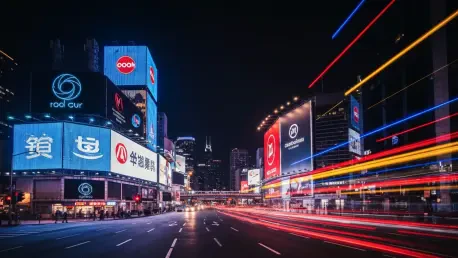

In an economy where consumer attention has become the most valuable and fiercely contested currency, the advertising industry is undergoing a profound recalibration away from sheer volume toward measurable engagement. Amid the clutter of skippable digital ads and fragmented media consumption, one channel is re-emerging not as a legacy medium, but as a technologically advanced and uniquely powerful force. Out-of-Home (OOH) advertising, supercharged by digital innovation, is proving its ability to capture the one thing marketers need most: undivided, real-world attention. Its physical presence makes it an unskippable and unblockable fixture in the consumer journey, positioning it as a central pillar for brands aiming to build lasting equity and drive tangible results in the years ahead.
The Unskippable Stage OOH’s Current Landscape and Transformation
The modern Out-of-Home ecosystem bears little resemblance to its static predecessors. The industry has evolved into a dynamic, data-driven powerhouse, led by the rapid expansion of Digital Out-of-Home (DOOH). This transformation has turned public spaces into sophisticated communication platforms, where messages are not just displayed but are delivered with contextual relevance and creative dynamism. The sector’s scale is significant, encompassing a diverse range of formats, from large-format roadside digital screens and immersive transit media within bustling transport hubs to place-based networks in shopping centers and office buildings.
This evolution is driven by technology that enables everything from programmatic buying to full-motion video and interactive content. Major market players are investing heavily in premium digital assets and advanced software stacks that allow for more seamless integration with broader marketing campaigns. At its core, OOH operates on the foundational principle of being a one-to-many medium in the public sphere, yet it is now infused with the intelligence of one-to-one digital targeting, creating a hybrid channel that offers both mass reach and refined precision.
The Great Recalibration How OOH Is Redefining Media Value
Beyond Impressions The Shift to Quality Attention and Creative Impact
A fundamental market driver reshaping the OOH industry is the decisive shift in marketer mindset from valuing impression quantity to demanding engagement quality. The era of prioritizing cheap media buys and chasing reach for its own sake is giving way to a more sophisticated focus on how well a message connects with the right audience. Marketers across sectors, from finance to fashion, are increasingly scrutinizing whether their investments are capturing meaningful attention or simply adding to the background noise. This recalibration places a premium on platforms that can deliver high-quality, memorable interactions.
This demand for quality is manifesting in several key areas. First, attention has become the primary metric for success, moving beyond simple viewability to measure active cognitive engagement. Second, technological advancements in DOOH are enabling more immersive and contextually aware creative, such as 3D visuals and campaigns triggered by real-time data feeds like weather or traffic. Finally, evolving consumer behaviors in the physical world—where people are often more present and receptive—make OOH a uniquely effective channel for cutting through digital fatigue and creating lasting brand impact.
By the Numbers Quantifying OOH’s Growth Trajectory
The industry’s pivot toward quality is substantiated by a strong growth trajectory and compelling performance data. Projections through 2026 indicate robust expansion, particularly within the programmatic DOOH (PrDOOH) segment. Having already surpassed a 10% market share in key markets, PrDOOH is on track to exceed 20% by the end of the decade, as automation and AI make it as seamless to transact as other digital channels. This allows advertisers to layer frequency against specific in-market audiences with unprecedented precision, accelerating outcomes.
Further bolstering this growth is the arrival of next-generation audience measurement systems. Tools like the new MOVE platform promise a holistic view of OOH audiences with greater temporal granularity, offering more detailed, time-based insights that significantly improve campaign planning and reporting. This is complemented by research quantifying the medium’s effectiveness, such as studies showing that a majority of premium DOOH sites achieve more than the 2.5 seconds of active attention required for an ad to be encoded into long-term memory. Such data provides concrete proof of OOH’s value, justifying a move toward quality-focused investments.
Navigating the Headwinds Overcoming OOH’s Modern Hurdles
Despite its bright prospects, the OOH industry faces several hurdles as it continues to scale and mature. A primary challenge lies in standardizing measurement across a vast and diverse array of formats, from giant roadside screens to small elevator panels. Creating a unified currency for attention and impact that is universally accepted by agencies and brands is critical for simplifying the buying process and demonstrating consistent value. Without it, the industry risks fragmentation and complexity that could slow adoption.
Moreover, ensuring the seamless integration of OOH into omnichannel marketing stacks remains a key objective. While programmatic technology has bridged many gaps, OOH is still sometimes perceived as a legacy medium operating in a silo. Overcoming this perception requires ongoing education to showcase its advanced capabilities and demonstrate its role as a powerful amplifier for digital, social, and mobile campaigns. By providing clear case studies and undeniable ROI, the industry can solidify its position as an indispensable, not just supplementary, part of the modern marketing mix.
Building Public Trust The Regulatory Framework in a Digital Age
As OOH becomes more data-driven and automated, navigating the evolving regulatory landscape is paramount. The use of audience data for programmatic targeting, even when anonymized and aggregated, brings data privacy into sharp focus. The industry must proactively adopt transparent and ethical data handling practices to maintain public trust and comply with regulations like GDPR and CCPA. Ensuring that targeting is executed responsibly is essential for positioning OOH as a safe and consumer-friendly channel.
Beyond data privacy, content standards in public spaces carry significant weight. OOH advertising is uniquely visible and cannot be easily ignored, placing a greater responsibility on brands and media owners to ensure that creative is appropriate, inclusive, and aligns with community values. Coupled with the need for robust cybersecurity to protect digital assets from unauthorized access or tampering, a strong commitment to compliance and self-regulation not only mitigates risk but also reinforces OOH’s reputation as a trusted and responsible medium.
The 2026 Horizon A Glimpse into the Future of Intelligent OOH
Looking ahead to 2026, the future of OOH is defined by the convergence of artificial intelligence, advanced data analytics, and full-funnel automation. These technologies are set to unlock a new level of intelligence for the medium, moving it from a broadcast channel to a truly dynamic and responsive platform. AI will not only optimize programmatic bidding and delivery but also serve as a catalyst for creative experimentation, enabling campaigns that adapt in real time to environmental cues, audience composition, and even cultural moments.
This technological fusion will enable unprecedented targeting precision and dynamic creative optimization, allowing brands to deliver hyper-contextual messages that are more relevant and impactful than ever before. The future will also see deeper integration with mobile and other digital platforms, creating a fluid feedback loop for measurement and attribution. Events like the Milano Cortina Winter Olympics in 2026 will serve as showcases for this intelligent OOH, where real-time content is delivered to highly attentive audiences, demonstrating the channel’s ability to create powerful, culturally resonant brand experiences.
The Final Verdict Why OOH Is an Essential Pillar for Future Growth
The evidence presented has demonstrated a clear and compelling case for Out-of-Home advertising’s elevated role in the modern media landscape. The industry’s strategic pivot from a volume-based model to one centered on quality, attention, and measurable outcomes has perfectly aligned it with the priorities of today’s marketers. Its inherent strengths—being an unskippable, high-impact public medium—are now amplified by a sophisticated technology stack that offers precision, accountability, and seamless integration. The convergence of superior attention metrics, advanced creative capabilities, and the efficiency of programmatic automation solidifies its position.
Consequently, OOH is no longer a tactical add-on but an essential, transformative partner for achieving sustainable growth. The question is no longer about its potential but about its execution. For brands and agencies ready to leverage its capabilities, the recommendation is clear: embrace OOH as a central component of strategic planning. By investing in quality assets, pushing creative boundaries, and demanding transparent, accountable outcomes, marketers can harness the full power of this revitalized channel to dominate in the attention economy and build brands that last.