In a world saturated with skippable online ads and endless digital noise, brands are looking for a more tangible way to connect with consumers. We’re joined today by Anastasia Braitsik, a leading expert in digital marketing and data analytics, to explore the powerful resurgence of Out of Home advertising. She’ll unravel how this traditional medium has evolved into a sophisticated, data-driven tool that blends physical presence with digital intelligence. We’ll discuss how transit advertising on tubes, trains, and buses creates lasting brand recall, how mobile and digital formats enable hyper-targeted urban campaigns, and why the physical world is becoming the most crucial frontier for building authentic brand trust.
The article contrasts the un-skippable nature of OOH with online ads. How does Lux Out of Home translate this physical advantage into measurable brand recall, and could you share an example of how a campaign’s strategic placement directly boosted real-world customer engagement for a client?
That’s really the core of why OOH is experiencing such a renaissance. Unlike a digital ad you can close with a click, a train car panel or a bus wrap is part of the physical environment. We translate this advantage into recall by focusing on strategic repetition within a person’s daily journey. We don’t just place an ad; we analyze audience movement patterns to ensure a brand becomes a consistent, familiar part of someone’s commute. For instance, we worked with a new retail brand opening in a major city. Instead of a broad, generic campaign, we focused all our efforts on the two specific Tube lines that fed directly into the shopping district where their store was located. By using a mix of platform posters and in-carriage ads, commuters saw the brand’s message every single morning and evening. The result was that on opening weekend, a significant portion of their initial foot traffic was from people who said they felt like they already knew the brand from their daily ride, demonstrating a direct link between targeted physical placement and real-world action.
Your text highlights the “repetitive exposure” opportunity in Tube and Train advertising. Could you walk us through the planning process for a transit campaign, detailing how you leverage data on commuter patterns to select placements and creative formats that maximize memorability?
Absolutely. The planning process is incredibly data-centric. We begin by looking at the sheer volume—millions of commuters using these networks every day—and then we start to segment that data. We analyze which lines and stations have the highest traffic during specific times, what the average dwell time is on a platform, and the demographic makeup of different routes. For a luxury brand, we might recommend a full “station takeover” at a hub in a financial district, using large-format digital screens to create an immersive, high-end experience for professionals waiting for their train. For a fast-moving consumer good, we might focus on interior panels inside the train cars themselves, where you have a captive audience for several minutes. The creative format is always tied to the context; a dynamic, eye-catching digital ad works best on a platform where people are stationary, while a simpler, bold message is more effective for a passing train. It’s about making every one of those repetitive exposures count by matching the message and format to the specific moment in the commuter’s journey.
You describe bus ads as “moving brand assets.” How do you strategically combine these high-frequency formats with Mobile OOH, like LED trucks, to create a multi-layered campaign that can dominate a specific neighborhood or event and amplify a brand’s message?
This is where OOH gets really exciting and dynamic. We think of buses as the steady heartbeat of a campaign—they are these incredible “moving brand assets” that ensure consistent visibility across a massive geographic footprint, from dense business districts to quiet residential neighborhoods. They build a broad, foundational layer of awareness. Then, we bring in Mobile OOH, like a digital LED truck, for a surgical, high-impact strike. Imagine a new beverage launching during the summer. We would have fully wrapped buses circulating the city for weeks, making the brand feel ubiquitous. Then, on the weekend of a major music festival, we deploy the LED truck to circle the event perimeter, playing vibrant, exciting video content. You create this incredible synergy where people who have been passively seeing the brand on buses for weeks are suddenly met with this powerful, focused message right at a moment of high energy and engagement. It’s a one-two punch that allows a brand to truly own a time and place.
Digital OOH is framed as a bridge between offline presence and digital strategy. Beyond scheduling ads by time of day, how do you use real-time data to customize messaging based on audience behavior, and what specific metrics demonstrate that this approach improves campaign efficiency?
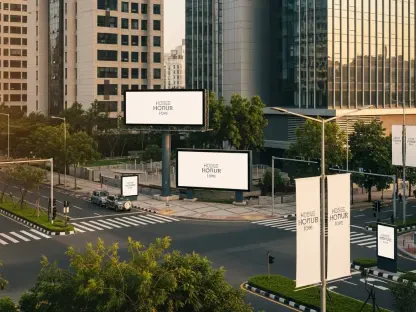
The real power of Digital OOH is its ability to be reactive and relevant. Scheduling ads for morning and evening commutes is just the beginning. We can integrate real-time data feeds to trigger specific creative. For example, a digital billboard near a stadium could show live game scores alongside a beer ad, or a screen in a shopping district could change its content to promote rain gear from a nearby retailer the moment a weather API detects rain. This level of customization makes the advertising feel less like an interruption and more like a helpful part of the environment. Efficiency is measured by the reduction in wasted impressions. Instead of showing the same ad to everyone, you’re delivering a message that’s perfectly timed and contextually relevant, which dramatically increases its engagement potential. Furthermore, the ability to A/B test creatives in real-time without any printing or installation costs allows us to optimize campaigns on the fly, ensuring we’re always running the most effective message.
The content mentions brands are turning to OOH due to “digital exhaustion.” What is the most compelling client result you’ve seen where an integrated OOH campaign created a more tangible and trustworthy connection with an audience compared to their previous digital-only efforts?
We recently worked with a direct-to-consumer brand that had built its entire business on social media advertising. They were hitting a wall; costs were rising, and they were struggling to be seen as anything more than another fleeting ad in a crowded feed. They were suffering from a trust deficit. We developed an integrated OOH strategy centered on Bus and Tube advertising. By placing their brand in the physical world, on the side of a bus that people saw every day or on a platform during their daily commute, something powerful happened. The brand suddenly felt more permanent, more legitimate. It became part of the city’s fabric. The most compelling result wasn’t just a lift in website traffic; it was a significant increase in their conversion rate and brand-name search queries. The OOH campaign provided the credibility and trust that their digital-only efforts couldn’t, warming up the audience so that when they did see a digital ad, they were already primed to believe in the brand.
What is your forecast for the future of Out of Home advertising as data integration and digital technologies become even more sophisticated?
My forecast is that the line between our digital and physical worlds will continue to blur, and OOH will be at the very center of that convergence. We’re moving beyond simple scheduling and toward fully programmatic, responsive campaigns that adapt in real time. Imagine digital screens that can anonymously detect the make of a car and serve a relevant ad, or transit ads that change based on train delays to offer commuters a deal at a nearby coffee shop. The future of OOH is one of hyper-relevance and seamless integration. It will no longer be treated as a separate silo but as a critical, un-skippable touchpoint in a truly omnichannel marketing strategy, offering brands the best of both worlds: the massive scale and impact of the physical world combined with the intelligence and adaptability of digital.